
Categories
Research & Analysis

The Em Dash: From Printing Press to AI Tell

Introduction

For centuries, the em dash has quietly served writers as one of the most expressive tools in punctuation—a simple line capable of interrupting thought, adding emphasis, or shifting tone mid-sentence. Born in the early days of typography and embraced by literary giants from Emily Dickinson to Virginia Woolf, the em dash has long been a hallmark of polished writing.

Yet in a curious twist of the modern digital age, this centuries-old punctuation mark has recently gained an unexpected reputation: some readers now see it as a sign that artificial intelligence may have written the text.

In an era suddenly obsessed with detecting machine-generated prose, even a piece of punctuation has become suspect.

This article explores the origins, evolution, and enduring usefulness of the em dash—along with the strange cultural moment that has turned a classic punctuation mark into an alleged AI fingerprint.

A Long Line Through History

There are few punctuation marks as quietly powerful as the em dash. It’s long, dramatic, and a little theatrical. It can interrupt a thought, insert a revelation, or punch up a sentence with sudden emphasis. For centuries, writers have used it as a stylistic flourish. Today, however, it has developed an entirely new—and somewhat strange—reputation: some readers now view it as a signal that a piece of writing might have been produced by artificial intelligence.

Which raises an odd question.

How did a piece of punctuation that predates the modern novel become associated with machine-generated text?

To understand that paradox, we need to go back several centuries—back to the birth of typography itself.

What Exactly Is an Em Dash?

An em dash (—) is the longest of the common horizontal punctuation marks. It is longer than both the hyphen (-) and the en dash (–).

The name comes from typography. In traditional typesetting, an “em” is a unit of measurement equal to the point size of the font being used. In 12-point type, for example, one em equals 12 points.

Historically, this measurement corresponded roughly to the width of a capital “M” in metal type, which is where the name originates.

That typographic origin is important. The em dash wasn’t invented by grammarians—it was invented by printers.

Hyphen vs En Dash vs Em Dash

These three marks are often confused, but they serve different functions.

Mark Symbol Typical Use Example
Hyphen Connect compound words well-known author
En dash Show ranges or connections 1998–2005
Em dash Interrupt or emphasize a sentence She had only one option—run

The Earliest Origins of the Dash

The conceptual ancestor of the modern dash dates back nearly a millennium.

One early precursor appears in the work of Boncompagno da Signa, an 11th-century Italian scholar who experimented with punctuation systems in medieval Latin manuscripts. His mark, called the virgula plana, resembled a long horizontal stroke similar to today’s em dash.

The mark’s early role was not stylistic—it was structural. Boncompagno used it as a flexible pause or separator within text.

However, the dash did not become widely standardized until much later.

The Dash Enters the Printing Age

When movable type printing spread across Europe in the 15th and 16th centuries, printers needed ways to represent pauses, interruptions, and rhetorical shifts in text.

By the early 1600s, long dashes began appearing in printed literature. Early examples appear in printed editions of Shakespeare’s plays, where they were used to signal interruptions in speech or sudden shifts in thought.

These early dashes were not standardized. Printers used different lengths and sometimes even composed them by stringing together multiple hyphens.

But the concept was there.

The dash had entered the written language.

The 18th Century: The Dash Finds Its Voice

If the dash had a literary champion, it would probably be Laurence Sterne, author of The Life and Opinions of Tristram Shandy, Gentleman (1759).

Sterne used dashes with wild enthusiasm. They appear throughout his novel, interrupting sentences, mimicking speech patterns, and creating dramatic pauses. His use of the dash helped legitimize it as a stylistic tool rather than merely a printer’s convenience.

The dash became a way to imitate thought itself—erratic, interrupted, and nonlinear.

Later writers embraced it as well:

  • Emily Dickinson filled her poems with dashes.
  • Victorian novelists used them for dramatic dialogue.
  • Modernists like James Joyce experimented with dash-based dialogue formatting.

By the 19th century, the dash had firmly embedded itself in literary style.

Famous Writers Who Loved the Em Dash

The em dash has been embraced by some of literature’s most distinctive voices.

Emily Dickinson

Dickinson’s poetry is perhaps the most famous example of em dash usage. Her dashes create pauses, uncertainty, and rhythm that feel closer to spoken thought than structured grammar.

Example:

Because I could not stop for Death —

He kindly stopped for me —

Her use of dashes was so distinctive that editors later struggled to standardize her punctuation without altering the feel of her poetry.

Virginia Woolf

Woolf used dashes to reflect interior thought and shifting perspectives in stream-of-consciousness narration.

Example style:

She had the oddest feeling—that something had just slipped away.

The dash becomes a psychological pivot point in the sentence.

Kurt Vonnegut

Vonnegut often used the dash to inject conversational timing and humor into his prose.

Example style:

He was a perfectly good engineer—until someone asked him to manage people.

The dash functions almost like a comedic pause.

Herman Melville

In Moby-Dick, Melville frequently used dashes in dialogue and narration to create dramatic interruptions.

Example style:

“Look ye now,” said Queequeg—“what you say?”

How Editors and Style Guides Tamed the Dash

For all its expressive power, editors have long had a complicated relationship with the em dash.

Most major style guides eventually formalized its use.

The em dash is typically used to:

  1. Insert a parenthetical aside.
  2. Indicate an abrupt shift in thought.
  3. Replace commas, parentheses, or colons for emphasis.
  4. Introduce lists or summaries.

Example:

She had three priorities in life—family, curiosity, and good coffee.

Editorial styles vary slightly.

  • Chicago Manual of Style recommends closed em dashes (no spaces).
  • Associated Press style often prefers spaced dashes.

Despite these differences, the em dash remained a hallmark of polished editorial writing.

You would routinely find it in:

  • Newspapers
  • Literary fiction
  • Magazine essays
  • Academic prose
  • Opinion columns

In other words, the em dash lived where edited writing lived.

Then the Typewriter Ruined Everything (Sort Of)

The 19th-century typewriter created an unexpected problem.

Most typewriters lacked dedicated keys for en dashes and em dashes. Writers were forced to approximate them using double hyphens (–). Over time, this convention carried into early word processors and digital writing systems.

Modern software eventually restored the true characters through auto-formatting.

But the em dash never quite regained its ubiquity in everyday writing.

Casual communication—emails, texting, social media—favored simpler punctuation.

And then something unexpected happened.

The Em Dash and the Rise of AI Writing

Around 2024 and 2025, an unusual cultural observation began circulating online.

Readers noticed that some AI-generated text—particularly text produced by ChatGPT—frequently used em dashes. Social media users jokingly referred to them as the “ChatGPT hyphen.”

The idea spread quickly:

“If a sentence contains an em dash, it must be AI.”

Of course, that claim is not actually true.

But it reflects a fascinating cultural shift.

Why AI Uses the Em Dash So Often

The explanation is surprisingly mundane.

Large language models are trained on enormous corpora of written text. Much of that text comes from sources such as:

  • Books
  • Journalism
  • Essays
  • Edited web content

These are precisely the environments where em dashes historically appear.

In other words, AI didn’t invent the em dash.

It simply learned from writers who were already using it.

Ironically, as everyday writing moved toward shorter, more conversational formats (texts, Slack messages, tweets), the em dash became less common in casual human communication. That created a strange perception gap.

To some readers, the mark now feels oddly formal.

Or suspiciously polished.

The Paradox of the Em Dash

This creates an unusual modern dilemma.

The em dash is:

  • Grammatically correct
  • Historically established
  • Stylistically expressive

Yet its presence can now cause readers to suspect that the writing might be artificial.

Some human writers have even begun avoiding the em dash deliberately so their writing does not appear AI-generated.

That is a remarkable reversal.

For centuries, the dash signaled sophistication.

Now, it can trigger skepticism.

What to Use Instead of an Em Dash (If You’re Trying to Avoid the “AI Look”)

If you suddenly notice that a piece of writing contains an unusual number of em dashes, the solution is not necessarily to delete them all. In many cases they are being used correctly. However, if you want the writing to feel more natural—or simply avoid triggering the increasingly common “AI radar”—there are several easy substitutions.

Replace the Em Dash With a Comma

Many em dashes simply introduce a brief aside that can be handled with commas.

Example with an em dash:

The project—originally scheduled for March—was delayed.

Rewritten with commas:

The project, originally scheduled for March, was delayed.

Use Parentheses for True Side Notes

Example with an em dash:

The proposal—still in draft form—will be reviewed next week.

Rewritten:

The proposal (still in draft form) will be reviewed next week.

Break the Sentence Into Two

Example with an em dash:

The team completed the migration—an effort that took nearly six months.

Rewritten:

The team completed the migration. The effort took nearly six months.

Use a Colon for Introductions

Example with an em dash:

She had three priorities—speed, reliability, and simplicity.

Rewritten:

She had three priorities: speed, reliability, and simplicity.

Use a Period for Emphasis

Example with an em dash:

There was only one option left—start over.

Rewritten:

There was only one option left. Start over.

When Writing Got Faster

One theory from editors and linguists is that this phenomenon reflects a deeper change in how people write.

Traditional publishing environments—books, newspapers, magazines—had editors who refined prose and encouraged expressive punctuation.

Modern digital writing often prioritizes speed, brevity, and clarity.

Short sentences.

Minimal punctuation.

Fast communication.

In that environment, the em dash can feel almost luxurious.

A relic of a slower editorial world.

How to Type an Em Dash on Any Device

Despite its long history, the em dash can sometimes feel oddly difficult to produce. That confusion largely comes from the typewriter era, when most machines lacked a dedicated key and writers improvised using double hyphens.

Modern devices, fortunately, make it much easier.

On Mac

Option + Shift + Hyphen

On Windows

Alt + 0151 (numeric keypad)

In Word or Google Docs

Two hyphens typed between words may automatically convert into an em dash.

On iPhone or iPad

Press and hold the hyphen key to reveal dash options.

On Android

Long-press the hyphen key to select different dash characters.

The Hidden Rhythm of the Em Dash

One reason the em dash has endured for centuries is that it does something most punctuation marks cannot: it captures the rhythm of thought.

Commas organize sentences. Periods stop them. Colons introduce structure.

The em dash does something more fluid.

It mirrors the way people actually think and speak.

A sentence begins in one direction—then pivots.

A thought is interrupted—then resumed.

A writer realizes something mid-sentence—and the dash lets the reader experience that realization at the same moment.

Consider the difference:

She had finally made a decision, although it took months.

vs.

She had finally made a decision—although it took months.

The dash introduces a pause and emphasis that feels closer to natural speech.

In Defense of the Em Dash

The recent suspicion surrounding the em dash is a little ironic.

For centuries it has been used by some of the most thoughtful writers in the English language. It allows sentences to breathe, pivot, and surprise the reader.

Few punctuation marks are as flexible.

It can replace commas.

It can replace parentheses.

It can even replace a colon.

And sometimes it simply does what no other punctuation mark can do—capture the way a thought actually unfolds in the mind.

If the em dash is suddenly suspect, perhaps the real question isn’t about punctuation at all.

Perhaps it’s about how our expectations of writing are changing in the age of AI.

The Em Dash Isn’t the Villain Here

If the em dash has suddenly become suspicious, the punctuation itself isn’t really the problem.

What we are witnessing is a cultural shift in how writing is produced, consumed, and judged. For centuries, polished writing passed through editors, proofreaders, and publishing houses. Today, much of our daily communication happens quickly—emails, chat messages, social media posts—often written in seconds and rarely edited.

In that faster environment, the em dash can stand out. It feels deliberate. Almost literary.

Artificial intelligence didn’t invent the em dash; it simply learned from the same sources human writers have relied on for generations: books, essays, journalism, and other forms of edited prose.

The irony, of course, is that avoiding the em dash entirely might make writing feel less natural—not more.

After all, the mark has survived more than a thousand years of evolving language, printing technologies, and editorial standards.

Blaming the em dash for AI writing is a bit like blaming the comma for emails.

It’s not the punctuation that changed.

It’s the world around it.

And if a single horizontal line can suddenly spark debates about authorship, authenticity, and artificial intelligence—perhaps the em dash is still doing exactly what great punctuation has always done: make us pause and think.
 

Categories
Events & Trade Shows

When Machines Enter the Control Room

The final vendor panel at Chesafest 2026 saved its most time-sensitive question for last.

For the first three panels, AI was a topic you could discuss at a philosophical remove. The file system will evolve over years. MAM architectures will shift over decades. Human oversight in media operations will be negotiated gradually. But in live broadcast, there is no gradually. A shot is taken or it isn’t. A graphic fires or it doesn’t. Audio goes to air or it goes silent. The decisions happen in real time, and the consequences arrive just as fast.

Moderated by Jason “Pep” Pepino, Director of Media Systems Design and Engineering at CHESA, Panel 4 brought together representatives from LiveU, Vizrt, Netgear AV, and AI Media to answer a question that gets more urgent every year: should AI be allowed to make real-time production decisions inside a live control loop, or should it remain strictly advisory?

The answer, as it usually does, landed somewhere in the middle. But the journey to get there was worth the trip.

MEET THE PANEL

Chuck Davidson — Partner Account Manager, LiveU

Chuck describes himself as an optimist, with a “glass half full” orientation toward technology in general and AI in particular. LiveU’s work in the bonded IP and remote production space means AI decisions at the transmission layer carry real operational stakes, and Chuck brought that weight to the conversation while maintaining his characteristic forward-looking energy.

Dan Griffin — Territory Manager, Netgear AV

Dan’s background is in live production audio, which gives him a different instinct than most people in a broadcast technology conversation. He showed up to Chesafest as a self-described skeptic (his wife, who works in tech, had been actively working on his conversion) and moved visibly toward realist over the course of the discussion. His perspective on AI in network design and audio mixing was among the most practically grounded of the session.

Kyle Phillips — VP of Sales Enablement, AI Media

Kyle acknowledged upfront that his pro-AI position at a company called AI Media was not exactly a surprise. What he brought beyond the predictable enthusiasm was specificity: real deployment context for live caption automation, guardrails design, and the practical limits of what AI can handle when breaking news or live sports throws something unexpected at the system.

Steve Cooperman — Sales Manager, Vizrt

Steve came in as the panel’s pragmatist, with 20 years of experience across Panasonic, Canon, and now Vizrt spanning cameras, live production, and software. He’s seen enough real-world deployments to know where AI delivers and where it overpromises, and he wasn’t shy about either.

Jason “Pep” Pepino — Director of Media Systems Design and Engineering, CHESA (Moderator)

Pep opened by declaring himself an accelerationist, the most enthusiastic position on the AI spectrum, and framed the panel accordingly. He had just finished building CHESA’s first SMPTE 2110 studio and had personally entered thousands of IP addresses by hand. His enthusiasm for an AI agent that could do that work someday was, as he put it, “real.”

SHOULD AI MAKE REAL-TIME PRODUCTION DECISIONS?

Pep opened by laying out what AI can already do in a live production environment. It can identify key moments. It can select camera angles. It can trigger graphics automatically. It can translate and localize audio in real time and adjust levels based on speaker detection. The question isn’t capability anymore. It’s authority.

Should the AI decide, or should it advise?

Steve Cooperman came in with a real-world example that illustrated both sides of the question simultaneously. Vizrt’s Libra product brings sports analytics into live production, powering the kind of on-screen overlays that have become standard in sports broadcasts. But beyond data visualization, the platform also handles AI cutouts: cleanly separating a player from the background in real time, handling edge cases like dark uniforms on grass, enabling 3D effect automation without a compositor doing it by hand.

“AI is really helpful for that cutout, and then automating it. Of course, we could always override it. But that’s a real-world example of production applications that some sports productions are using today.”

The override option is the tell. Even in a case where the AI is clearly adding value, the ability to override it is treated as non-negotiable. The automation runs unless a human says otherwise.

Chuck Davidson framed LiveU’s approach as one of intentional flexibility. Their CTO’s current development focus is something called an AI connector, essentially a configurable entry point into the LiveU ecosystem that lets each customer define which AI agent they want to use and how much authority it gets. The premise: there is no universal right answer for how much AI authority is appropriate. It depends on the customer, the content, and what’s at stake.

“We can’t assume that everybody’s going to want to have the same parameters or the same mindset for how they want to integrate AI.”

Dan Griffin brought the audio mixing perspective, and it was one of the most honest assessments of the session. When it comes to managing microphone levels for a group of talking heads, he said flatly, machines can do it better than humans. They react faster. They don’t get fatigued. They don’t miss a cough. For that specific task, in that specific context, AI authority isn’t a philosophical question. It’s just more reliable.

But the right answer shifts dramatically when you change the context. Life-critical broadcasts, high-stakes live events, anything where a muted microphone could mean something goes out wrong or doesn’t go out at all: those require human readiness to intervene, even if AI is handling the moment-to-moment operation.

Kyle Phillips introduced a concept that became one of the most useful frameworks of the session: bounded autonomy. You define the space in which AI is allowed to act, and the machine operates confidently within that space. The boundaries are the human decision. The execution within them is the machine’s.

“You design what it’s able to do. When you can replace manual, repetitive tasks with AI, you get efficiency and speed. But you give it parameters. It can adjust levels a few decibels, but it can’t go from zero to twenty all at once.”

The design phase is where human judgment lives. The operational phase is where the machine works. Keeping those two things clearly separated is the architectural foundation of responsible AI deployment in live production.

WHEN AI FAILS: WHO’S RESPONSIBLE?

Pep shifted the conversation to accountability, and the panel’s first response was telling: someone immediately said “the systems integrator,” then immediately acknowledged they were not supposed to say that.

The laughter that followed said something real. In the live production chain, when something goes wrong, the question of who owns it is genuinely complicated.

Kyle Phillips was direct: if the AI is failing, it’s ultimately on the vendor. But the more important variable is how the system was designed and what parameters were set. You can’t blame the machine for operating within the boundaries someone gave it. The accountability traces back to whoever set those boundaries.

Chuck Davidson took a different angle. LiveU’s acquisition of Actus (a compliance monitoring platform) started making sense to him in this context in a new way during the panel. Actus was built for FCC compliance monitoring, essentially an automated oversight layer that watches what goes to air and flags violations. As AI takes on more production authority, a compliance layer like that becomes part of the answer to the accountability question. It’s governance infrastructure for an AI-driven environment.

Pep offered his own ground-level perspective: having just spent significant time manually entering IP addresses to configure CHESA’s 2110 studio, he’s acutely aware of how much room there is for AI to help with the configuration and commissioning process, and equally aware of how much human verification that work currently requires. The AI can assist. The engineer still has to verify.

GUARDRAILS: WHAT MUST EXIST IF AI IS IN THE CONTROL LOOP?

The panel’s final formal question was the most practical: if AI is operating inside the signal chain, what guardrails must be in place?

The consensus was rapid and clear: operator override is non-negotiable. Every panelist said some version of it.

Steve Cooperman used Vizrt’s gaze correction feature on the TriCaster as a live illustration. The feature automatically adjusts a speaker’s eye line to maintain direct-to-camera contact even when they’re looking down at a monitor. It works well most of the time. It does not work well when someone is moving erratically, and a malfunctioning gaze correction in the middle of a live broadcast creates a deeply unsettling viewer experience. The human has to be able to turn it off. Immediately. Without friction.

“You need a human, presumably, to be able to override or to monitor. If any technology goes bad, you want the ability to turn it off if it’s not working in that environment properly.”

Kyle Phillips described the guardrails in AI Media’s captioning deployments in specific terms. AI handles the placement of captions in real time, dynamically repositioning them so they don’t block on-screen text like lower thirds or score bugs. That’s clean, bounded automation. But then there’s the harder layer: topic models and content filters that prevent certain words from appearing in captions when a speaker has a particular accent or when a live sports moment generates unexpected language. Those filters need to be configurable, auditable, and human-adjustable in the moment.

Dan Griffin brought it back to the network layer. Netgear’s value-add includes free network design services. AI can help design a network much faster than doing it manually. But an engineer still puts eyes on every design before it goes to a customer. Not because the AI is unreliable, but because the stakes of a poorly configured live production network are too high to skip the human review, regardless of how good the last ten designs were.

“The thing to fear is getting too comfortable. You always have to look and make sure you’re monitoring what it’s doing and providing feedback as needed.”

Chuck Davidson closed the guardrails discussion with the framing that felt most honest about where the industry actually is: this is a change management problem as much as a technology problem. The resistance to AI in live production isn’t always about legitimate technical concerns. Sometimes it’s just that change is scary, and AI is a category of change that the industry has no prior template for. The tape-to-digital transition felt just as existential at the time. Many broadcasters refused to let go of physical tape long after digital was the better answer.

“Part of the challenge is that change is scary, and AI is a very powerful tool that this industry has never seen before. Part of our job on the technology side is how do we harness it and how do we manage it to eliminate the fear.”

WHERE ARE WE ON THE INNOVATION CURVE?

An audience question brought the session to its most forward-looking moment: where are we on the innovation curve for visual AI in live broadcast?

Pep didn’t hesitate: we’re at the very beginning. The capabilities visible today will look primitive compared to what five to ten years will produce. The panel agreed.

Dan Griffin noted that even the most basic AI research tools (looking up someone’s background before a meeting, pulling a bio from the web) were significantly worse just six months ago than they are now. The trajectory of improvement is steep. Broadcast-specific applications are more complex and more critical than general research tools, which means they’ll take longer to mature. But the same rate of improvement will get there.

Steve Cooperman pushed back slightly on “very beginning.” In live sports specifically, the volume of AI-driven sports tech visible on broadcast in the last year is roughly ten times what it was before. Not all of it is AI in the strict sense, but the category of computer-assisted production technology has exploded, and AI is a meaningful part of that acceleration.

Kyle Phillips connected this to the economics of linear broadcast. Traditional linear television is under revenue pressure, and that pressure is creating urgency around monetizing existing content in new ways. Old archives, up-rezzed to modern quality, localized for new markets, offered on emerging platforms (he pointed to retro TV services running on antenna signals with commercials as a surprisingly significant revenue generator) represent a category of AI-driven value that is very real, very current, and still early.

A voice from the audience painted one of the most vivid pictures of where this heads. Imagine taking old television series and not just up-resing them, but giving them new language tracks where the original actors’ voices are preserved but given the phonetic quality of the target language’s native speakers. Not a new voice actor. The original voice, delivered as if the original actor had learned to speak Hindi or Spanish natively. The legal questions around that are still being worked out. The technology to do it exists now.

Chuck Davidson offered the most memorable real-world deployment of the session: the NYPD’s Drones as First Responder program in New York City. Drones dispatched autonomously in response to 911 calls, giving officers visual intelligence on a scene before they arrive. Operational today. No lab demo. No pilot program. Running in the city.

“If you’ve never seen it, I would encourage you to watch it. It’s a great example of where we are from a technology perspective.”

It’s not a broadcast example. But it’s the clearest illustration of what bounded AI autonomy looks like when it works: a machine operating within carefully designed parameters, doing something faster and more effectively than any human alternative, with humans ready to act on what it finds.

THE THROUGH LINE ACROSS ALL FOUR PANELS

Across the four Chesafest vendor panels, the same idea surfaced in every room, in different forms and different vocabularies, and it’s worth naming it clearly.

The question was never really “AI or humans.” It was always “what do we want the humans to do?”

In storage and file systems, we want humans setting governance policy, not manually moving files. In MAM, we want humans defining taxonomy and verifying results, not logging 20-year-old archives by hand. In media operations, we want humans deciding what the work is and evaluating what comes out, not checking codec values on every ingest. In live production, we want humans making editorial decisions and ready to override, not manually adjusting audio levels for twelve talking heads who all speak at different volumes.

The machines are getting better at the things humans shouldn’t have to do. The work of the industry right now is figuring out exactly where that line is, drawing it deliberately, and building the guardrails to hold it.

That’s not a 2030 problem. It’s a now problem. And it was the right note to end Chesafest 2026 on.

ABOUT CHESAFEST

Chesafest is CHESA’s annual gathering of team members, technology partners, clients, and practitioners in the media, broadcast, and AV space. It blends the energy of a partner kickoff with substantive, practitioner-driven conversation about where the industry is actually headed.

Now in its 4th year, Chesafest has grown into something genuinely distinct: a program where CHESA’s team, its vendor partners, and its clients are all in the same room at the same time, participating in the same conversations. The panels are designed to surface real disagreement, real tradeoffs, and real-world insight. The 4th Annual Chesafest took place on February 25, 2026 in Towson, Maryland, drawing 19 vendor partners and a cross-section of CHESA’s client community.

The four vendor panels from Chesafest 2026:

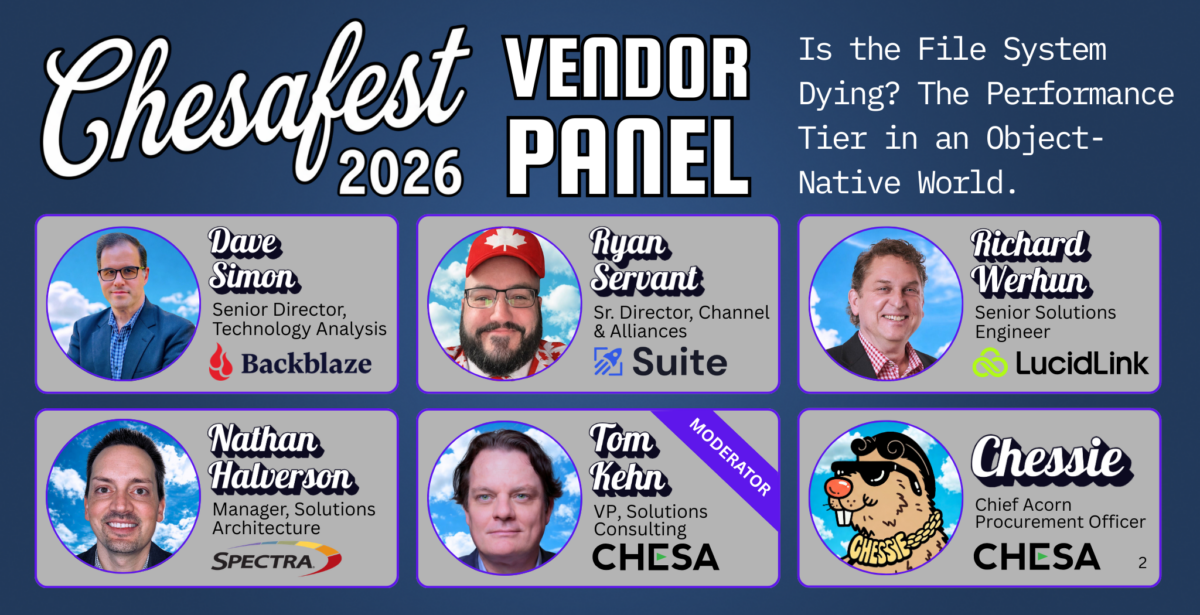
Vendor Panel 1: Is the File System Dying? The Performance Tier in an Object-Native World

Featuring: Backblaze, LucidLink, Suite, and Spectra Logic | Moderated by Tom Kehn, CHESA

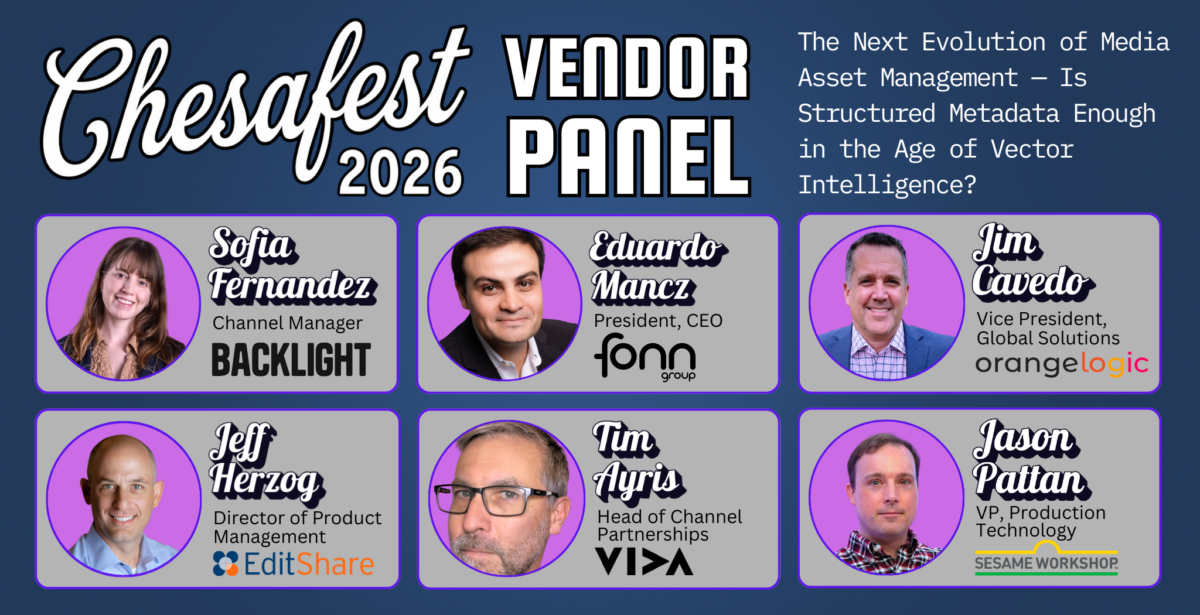
Vendor Panel 2: The Next Evolution of Media Asset Management: Is Structured Metadata Enough in the Age of Vector Intelligence?

Featuring: Backlight, Fonn Group, OrangeLogic, EditShare, and VIDA | With client perspective from Jason Patton, Sesame Workshop | Moderated by Felix Coats, CHESA

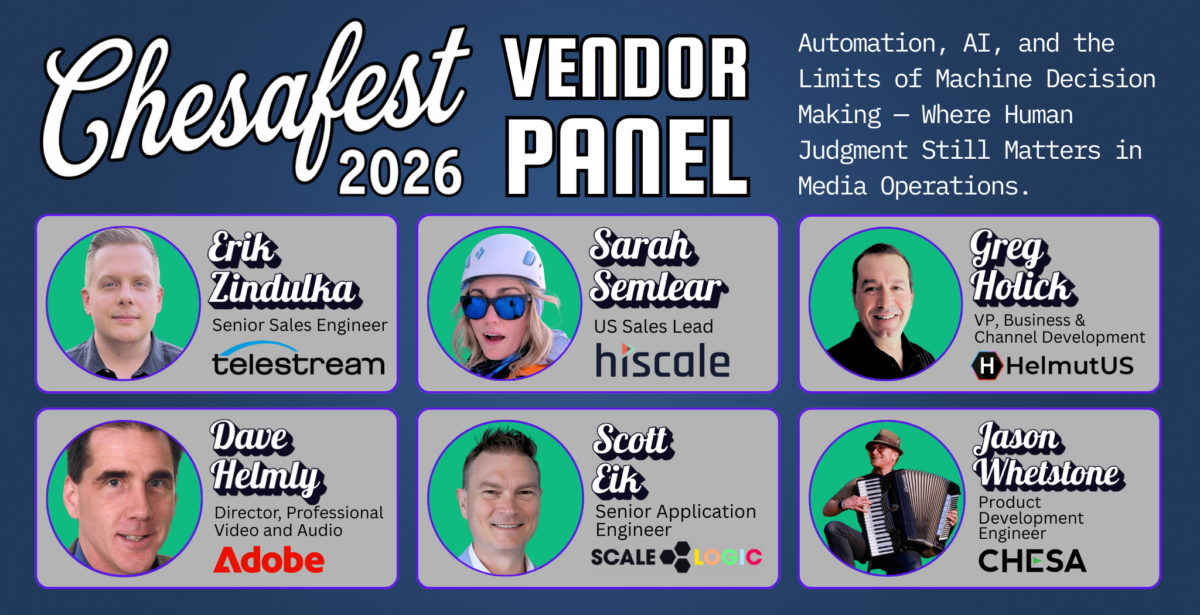
Vendor Panel 3: Automation, AI, and the Limits of Machine Decision-Making: Where Human Judgment Still Matters in Media Operations

Featuring: Telestream, Hiscale, HelmutUS, Adobe, and Scale Logic, with Jason Whetstone, CHESA | Moderated by Felix Coats, CHESA

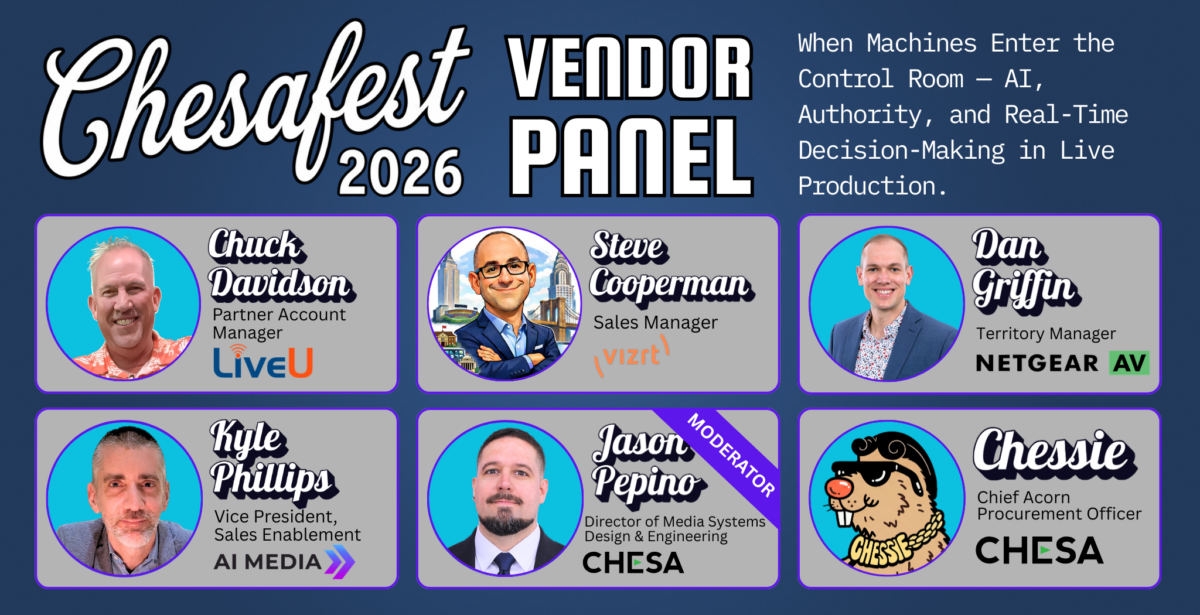
Vendor Panel 4: When Machines Enter the Control Room: AI, Authority, and Real-Time Decision-Making in Live Production

Featuring: LiveU, Vizrt, Netgear AV, and AI Media | Moderated by Jason “Pep” Pepino, CHESA

This blog series covers each panel in depth. If the live production and AI authority conversation is in your world, the other sessions are worth your time too.

Categories
Events & Trade Shows

Automation, AI, and the Limits of Machine Decision-Making

The third vendor panel at Chesafest 2026 started with a question that sounds deceptively simple: how much of what media operations teams do today will be done by machines by 2030?

The answers ranged from 70% to 99%. And the real conversation was everything in between.

Moderated again by Felix Coats of CHESA, Vendor Panel 3 brought together practitioners from Telestream, Adobe, HelmutUS, Hiscale, and Scale Logic, alongside CHESA’s own Jason Whetstone, for a conversation about automation, accountability, and the specific kinds of decisions that still need a human in the room. The panel covered everything from the philosophy of machine morality to a story about a guy downloading Python at the gym and submitting the output to his boss without checking a single line.

It was a good panel.

MEET THE PANEL

Scott Eik — Senior Application Engineer, Scale Logic

Scott has been in the industry for about 16 years, moving between MAM systems, archive systems, and the customer side. He joined Scale Logic at NAB the prior year and brought a grounded, operational perspective to every question.

Dave Helmly — Director of Professional Video and Audio, Adobe

Dave has been at Adobe for 30 years and leads a workflow strategy and development team of 22, the only team of its kind embedded in Adobe’s engineering organization. His philosophy: trust your customers to tell you how to make your software. He’s been working with CHESA for most of his time there.

Greg Holick — VP of Business and Channel Development, HelmutUS

Greg has been in the M&E industry for over 25 years, with deep experience helping large customers architect and orchestrate complex media workflows. He came in as the voice of measured optimism: enthusiastic about AI’s potential, clear-eyed about the things it still can’t do.

Sarah Semlear — US Sales Lead, Hiscale

Sarah came to Hiscale after spending time on the client side, deploying MAMs and transcode systems from the inside. She showed up at Chesafest the prior year as a client. She brought the most infectious energy to the panel and consistently redirected the conversation toward what matters: whether any of this is actually making work more fun.

Erik Zindulka — Senior Sales Engineer, Telestream

Erik spent eight or nine years as a Telestream customer before joining the company. He described himself as “the MAM nerd in some circles at Telestream” and brought a practitioner’s sensibility to questions about automation, enrichment, and where AI fits into workflows people are already building.


Jason Whetstone — Product Development Engineer, CHESA

Jason has been at CHESA for 12 years and in the media industry for close to 18. He brought a developer’s precision to the panel: focused on what “done” actually means, why AI needs humans to define the work, and what pair programming has to teach us about working with AI tools.

Felix Coats — Solutions Consultant, CHESA (Moderator)

Felix moderated his second panel of the day and, per his own admission, had prepared a full list of questions that the panelists proceeded to answer before he could ask them. He pivoted gracefully throughout and introduced the gym story that became the thread everyone kept pulling on.

BY 2030, WHAT PERCENTAGE OF MEDIA OPERATIONS WILL BE FULLY AUTOMATED?

Felix opened with a clean, direct question and asked each panelist to answer it honestly: by 2030, what percentage of media operations in your space will be fully automated?

The answers were telling.

Dave Helmly went first and went highest: 99%. His reasoning was precise. Adobe’s AI work, particularly with Firefly Services, is focused on productivity and batch automation (resizing, reformatting, localization across 400 output variants from a single source). The jobs nobody wants. A creative still starts the job, still reviews the rejections, still makes the final call. But the volume of mechanical work being handed to machines is already enormous, and it’s only going in one direction.

Scott Eik landed at 70 to 80%, acknowledging that some human interaction will persist but that the trend is unmistakably toward automation for the operational layer.

Greg Holick took a longer view and came in at 50 to 70%. His reasoning was rooted in what AI currently lacks: creative intent, cultural inference, the subtle judgment calls that define the difference between technically correct and actually good. He’s watched the industry’s AI capabilities grow and believes they’ll continue to grow, but maintains that the creative mind brings things to the table that can’t be encoded.

Sarah Semlear declined to give a number. Her answer was better than a number: if we want the future of media to be fun, there has to be human interaction. The machines should own the tedious, horrible tasks. The calculator analogy she returned to repeatedly was perfect: a calculator doesn’t replace the mathematician. It removes the arithmetic so the mathematician can think.

“Let the machines do the tedious, horrible tasks that we don’t want to do. Then we’re focusing on the really awesome, juicy, creative, fun stuff. That’s not Skynet. That’s a utopia.”

Erik Zindulka pointed out that the “extreme majority” of media operations tasks that AI is being asked to automate are things that customers have wanted machines to handle for years. A file lands in a folder. Twenty things should happen to it automatically. Nobody should be sitting in a cubicle checking the codec and moving it to the right directory. AI is the natural continuation of automation logic the industry has been building for decades.

Jason Whetstone offered the most structurally precise answer: as long as humans are creating content and consuming content, the system can never be fully automated, and shouldn’t be. The human role shifts, but it doesn’t disappear. The job becomes defining the work, being clear with the machines about what “done” means, and reducing the exceptions that fall outside the automation envelope.

“Our job as humans is determining what the work actually is and being very clear with the machines about what the work is and how we want it done.”

WHERE HUMAN JUDGMENT IS NON-NEGOTIABLE

Felix pushed the panel on a harder question: are there operational decisions that cannot safely be automated today? And will they ever be able to be?

Erik Zindulka surfaced a quote that became a reference point for the rest of the panel, a placard from an IBM training program from 1979 that read: “A computer cannot be held accountable, therefore it cannot make a management decision.”

That sentence from nearly 50 years ago maps almost perfectly onto the AI governance debate happening right now. Accountability is the line. Wherever a decision has legal consequences, creative stakes, or reputational exposure, a human needs to be in the chain, not because machines can’t generate an answer, but because machines can’t be held responsible for the answer they generate.

Sarah Semlear picked up the accountability thread with a specific point about morality. The industry often talks about training AI to be ethical or unbiased. But morality isn’t a universal constant. It varies by culture, country, context, and situation. You can’t hand a one-size-fits-all moral framework to an AI and consider the problem solved.

Greg Holick added the copyright and compliance dimension: AI in a media environment has access to enormous volumes of protected content. Should it? The legal exposure of an AI system pulling the wrong ad, using the wrong asset, or making a rights decision it can’t justify is enormous. And the entity that gets held responsible isn’t the machine.

Dave Helmly extended this into the personalization and content consumption space: AI is already learning individual users well enough to feed them content they’ll react to. By 2030, it will know users dramatically better than it does now. That creates an obligation on the human side to question what’s being surfaced, why, and whether the information environment being constructed serves the person or just the engagement metric.

Jason Whetstone brought it back to something clean and practical: the decision to publish. You can automate the upload. You can automate the metadata. But the decision to put content in front of an audience should require a human making a deliberate choice.

“The decision to actually publish to the public should be on a human.”

Dave Helmly also noted where compliance automation actually adds value: territory-specific edits, regional restrictions, content standards for different markets. These are the jobs that no one wants to do anyway, that currently require enormous manual effort, and where AI can do the work reliably because the rules are known and explicit.

Scott Eik grounded the whole discussion with a production operations lens: someone has to QC what comes out the back end before it goes to air or to print. That checkpoint is a human checkpoint. The question isn’t whether the QC role exists; it’s whether AI can support it by catching more before it reaches the human reviewer.

THE GYM STORY: LOW CODE, UNMANAGED RISK, AND THE GUY WHO SUBMITTED THE PYTHON SCRIPT

Felix opened the third segment with a story that generated more discussion than any formal question could have.

He overheard two finance professionals at the gym. One of them had been asked by his boss to produce some charts. He didn’t know how. He asked ChatGPT. ChatGPT told him to download Python. He asked how. ChatGPT told him. He installed it, ran the script, and submitted the output to his boss. His boss said great job. He was proud of himself.

Felix’s internal reaction was a list of questions he didn’t say out loud: Did you validate the code? Did you confirm it wasn’t also accessing your financial records from the last decade? Did you check what it was touching?

This is the low code moment the industry is living in right now. The tools have gotten accessible enough that people with no technical background are generating and running code that touches real systems and real data. The gap between capability and comprehension has never been wider.

Scott Eik was direct: you have unmanaged risk the moment you don’t understand what’s happening in the background. And when something goes wrong, the person who ran the script without understanding it is not equipped to diagnose or fix it.

Dave Helmly raised the IP dimension: code generated by AI may have been derived from copyrighted source material. If you don’t know math, you can’t validate the logic. If you don’t know code, you can’t validate its origins. The people who are safe in this environment, he argued, are the ones with 10,000 hours in their specialty. They’re the ones qualified to judge what the AI produced.

Greg Holick brought it back to responsibility: automation and AI are extraordinary productivity tools, but they change who’s responsible for the outcome. The ownership lands on the person who ran the process. If you deployed code that touched data you shouldn’t have touched, the fact that an AI wrote it doesn’t reduce your exposure.

“Just because you can do it doesn’t mean you should. Automation and AI change your responsibility. The ownership is still on the person doing that.”

Sarah Semlear offered the most optimistic frame. She compared the current moment to the early days of YouTube, when traditional media companies were horrified by the chaos of user-generated video flooding the internet. People posting content they shouldn’t, no standards, no guardrails. It looked like a disaster. It became an industry. The wild west always calms down.

“Everything always calms down. It’ll be fine. We’ll get to the place where it’s actually that super powerful calculator we really need.”

Erik Zindulka pushed toward the practical design goal: the end state for low code in a media environment isn’t Python scripts generated in a gym. It’s a visual workflow builder where an operator draws a flowchart, describes the production logic they want, and the system handles the execution. Bring-your-own-code for edge cases, yes. But the default should be intuitive enough that nobody has to think about scripting at all.

Jason Whetstone added the concept of AI context: an AI system is results-driven and will generate an answer as fast as possible, even if it doesn’t have all the information it needs to get the right answer. If it’s missing context, it guesses. That’s where the human has to step in: not to do the work, but to be clear about what the work actually is.

He described two models of working with AI tools. The substitutive model: you outsource a task to AI and don’t particularly care how it gets done. The assistive model, which he prefers, is pair programming. Two people working shoulder to shoulder through a problem, each learning from the other. You understand the problem. The AI understands aspects of the code you don’t. You teach each other. The outcome is better because both parties are engaged in the process.

“I have to help the AI understand what the problem is that I’m trying to solve, what I’m not trying to solve, what good results look like, what success means, and what done means.”

THE FUTURE OF HUMAN OVERSIGHT: AI MONITORING AI?

Felix closed the formal portion of the session with a question about where human oversight goes as AI-native workflows mature. Do you create new roles to supervise AI output? Do you build AI to monitor AI? Or does the oversight layer gradually get automated away too?

The panel converged on a few consistent positions.

Scott Eik: in the near term, you want humans checking everything that comes out of AI. As trust is established over time, that check can become more targeted and less constant. The progression is gradual. You don’t just flip a switch.

Dave Helmly: AI is going to take some jobs. Photoshop took jobs too. But Photoshop created entirely new categories of work. The pattern holds. The people who lose jobs will be the ones who tried to use AI as a shortcut without understanding the underlying craft. The ones who keep their jobs, and build new ones, will be the ones who can judge what the machine produced.

Sarah Semlear: you don’t need to reinvent the wheel. The organizations that respond to AI by blowing up their org charts and starting over are making the same mistake people make with every major technology shift. Find the efficiencies. Add the roles where they’re needed. Check your sources, which is not a new skill requirement. Keep humans in the loop and keep it interesting.

“If you just take a base answer of anything and you don’t look into it, if you Google one thing and go with the first result, you should probably be fired for that too. This is not something new in humanity.”

Erik Zindulka offered one of the most forward-looking points of the session: AI enrichment isn’t a one-time event. Archives and libraries persist for decades. An archive enriched by one AI tool today will be enriched again five years from now by a better one. And again five years after that. Each pass adds another layer of metadata, another dimension of searchability, another tier of context. The result, over time, is a media archive richer than anything that could have been produced by human logging alone.

Greg Holick closed with a framing that landed well: AI changes the shape of human responsibility, but not its existence. Someone still has to set up the guardrails. Someone still has to evaluate what comes out. The pre-checking that happens before automation runs may matter as much as the post-checking that happens after.

Felix added one more thought before closing: the industry might start seeing something like a “production AI supervisor,” a new role whose job is specifically to QC AI output before it hits a downstream system or a human audience. Not a developer. Not a traditional post supervisor. Something in between. It’s not here yet, but the logic is sound.

A CLOSING QUESTION FROM THE CEO

As the session wound down, Jason Paquin stepped in with one last question for the group: what guidance do you have for someone building their career in this space right now?

It was a good question to end on, and Nina Smith gave the best answer.

She said that the greatest gift you can give anyone you’re talking to is the ability to truly listen. Not to have the answer ready before the question is finished. Not to perform expertise before you’ve understood the problem. Holding back, listening, and offering real perspective when you actually have something to contribute will take you further than sounding smart ever will.

“Know who you’re dealing with. If someone wants to talk fluff, talk fluff. If someone wants to talk truth, talk truth. You will go much further by listening and learning and offering your advice when you really know something, not when you’re guessing.”

That’s good advice in any era. In an industry moving as fast as this one, it’s essential.

ABOUT CHESAFEST

Chesafest is CHESA’s annual gathering of team members, technology partners, clients, and practitioners in the media, broadcast, and AV space. It blends the energy of a partner kickoff with substantive, practitioner-driven conversation about where the industry is actually headed.

Now in its 4th year, Chesafest has grown into something genuinely distinct: a program where CHESA’s team, its vendor partners, and its clients are all in the same room at the same time, participating in the same conversations. The panels are designed to surface real disagreement, real tradeoffs, and real-world insight. The 4th Annual Chesafest took place on February 25, 2026 in Towson, Maryland, drawing 19 vendor partners and a cross-section of CHESA’s client community.

The four vendor panels from Chesafest 2026:

Vendor Panel 1: Is the File System Dying? The Performance Tier in an Object-Native World

Featuring: Backblaze, LucidLink, Suite, and Spectra Logic | Moderated by Tom Kehn, CHESA

Vendor Panel 2: The Next Evolution of Media Asset Management: Is Structured Metadata Enough in the Age of Vector Intelligence?

Featuring: Backlight, Fonn Group, OrangeLogic, EditShare, and VIDA | With client perspective from Jason Patton, Sesame Workshop | Moderated by Felix Coats, CHESA

Vendor Panel 3: Automation, AI, and the Limits of Machine Decision-Making: Where Human Judgment Still Matters in Media Operations

Featuring: Telestream, Hiscale, HelmutUS, Adobe, and Scale Logic, with Jason Whetstone, CHESA | Moderated by Felix Coats, CHESA

Vendor Panel 4: When Machines Enter the Control Room: AI, Authority, and Real-Time Decision-Making in Live Production

Featuring: LiveU, Vizrt, Netgear AV, and AI Media | Moderated by Jason “Pep” Pepino, CHESA

This blog series covers each panel in depth. If the automation and AI accountability conversation resonates with your world, the other sessions are worth your time too.

Categories
Events & Trade Shows

The Next Evolution of Media Asset Management

The 4th Annual Chesafest didn’t slow down after its opening session. Vendor Panel 2 took the intellectual temperature in the room and raised it by a few degrees.

The question on the table: Is structured metadata still enough to run a modern media asset management system, or is the rise of vector databases and AI-driven semantic retrieval about to fundamentally reshape how media organizations find, govern, and work with their content?

It sounds like an infrastructure question. It turned out to be a conversation about users, governance, trust, library science, Star Trek, and the surprisingly stubborn challenge of teaching a machine to know what you actually meant.

Moderated by Felix Coats of CHESA, the panel brought together practitioners and vendors from across the MAM ecosystem, a mix of perspectives that produced one of the most substantive conversations of the day.

MEET THE PANEL

Jason Patton, VP of Production Technology, Sesame Workshop

Jason was a late addition to the panel, he’s a great duck pin bowler. He’s not a vendor; he’s a client, and his real-world perspective on what it actually means to manage a deep archive of beloved children’s content grounded every abstract technology debate in something concrete. His candor was a consistent highlight throughout.

Tim Ayris — Head of Channel Partnerships, VIDA

Tim brought a content operations lens to the conversation. VIDA’s customers use the platform to push and manage content at scale, which means the governance question isn’t theoretical, it’s something they have to solve for every day.

Jeff Herzog — Director of Product Management, EditShare

Jeff came in with a product-depth perspective and a healthy skepticism about the pace of vendor hype versus the pace of actual customer adoption. His point that many customers are skeptical of MAM value, and that AI enhancement layers could change that permanently, set a useful frame early.

Jim Cavedo — VP of Global Solutions, OrangeLogic

OrangeLogic occupies a unique position: a single platform with both DAM and MAM capabilities. Jim brought the agentic AI angle to the conversation and was consistent on one point throughout: the user shouldn’t know or care whether the system is querying a relational database or a vector database. That’s the vendor’s problem to solve.

Sofia Fernandez — Channel Manager, Backlight

Sofia offered clear, precise framing throughout, including one of the best analogies of the session, which involved a coffee machine. She brought a measured view of how the transition from structured to semantic metadata needs to be paced carefully to avoid breaking the users who depend on deterministic search today.

Eduardo Mancz — President and CEO, Fonn Group (Mimir)

Eduardo’s company builds Mimir, a MAM platform well known in the broadcast and media space. He pushed the conversation toward the practical: the complexity of metadata that organizations are already struggling to manage, and the risk of chasing AI capabilities without solving for portability and platform evolution.

Felix Coats — Solutions Consultant, CHESA (Moderator)

Felix opened with a technical level-set that would have impressed a database administrator, covering the core difference between relational and vector databases with enough clarity that the conversation could actually go somewhere. He kept the panel honest and on-topic throughout, and closed with a Star Trek reference that was far more apt than it had any right to be.

THE SETUP: TWO VERY DIFFERENT WAYS OF KNOWING THINGS

Felix opened by drawing a distinction that the industry tends to collapse into buzzwords. A relational database, he explained, is like a well-organized spreadsheet. You know what you’re looking for, you query it precisely, and you get back an exact match. Tomato is a vegetable. Find all videos from 1994. Return assets with active rights for North America.

A vector database works on a completely different principle. It doesn’t retrieve based on declared, structured facts; it retrieves based on similarity and meaning. A cat and a dog aren’t the same animal, but they share enough dimensional proximity in a vector space that a search for “pet” could surface both. It’s powerful for finding things you can’t precisely describe. It’s problematic when you need to know for certain.

The question Felix posed: MAM systems have been built for decades on the declared-truth model; relational databases, structured schemas, deterministic queries. Now users expect systems to understand intent. Can these two models coexist? Or are they philosophically incompatible?

The panel’s answer, reached almost immediately and reinforced throughout: they don’t just coexist, they depend on each other.

“THEY’RE GOING TO HAVE TO LIVE TOGETHER”

Jason Patton got there first, and said it most plainly. A unique identifier, the foundational record that says this asset exists and relates to these other assets, is never going away. That’s relational. That’s structural. That has to be right. But layered on top of that, and running alongside it, is where vector search lives: helping a new generation of users who have grown up talking to chatbots, who don’t know the naming convention, who have a fuzzy idea of what they’re looking for and want the system to meet them there.

“There’s going to be a whole new crop of users whose only experience is talking to a chatbot. They’re going to be like, ‘I don’t know what I want.’ They want the system to come back and say, here are things that are like what we think you’re saying.”

Tim Ayris agreed, adding a dimension specific to VIDA’s user base: the creative users who are doing production work don’t want to learn a taxonomy. They want to type something that approximates what they’re looking for and get results. But the operational users, the ones pushing content, managing distribution, handling rights, need the precision that only a relational database can provide. The same platform has to serve both.

Jeff Herzog came at it from a MAM adoption angle. Many of EditShare’s customers have MAM access but don’t fully use it. They’re skeptical. The value isn’t obvious enough yet. His contention: AI enhancement layers change that equation. Once semantic search makes finding content genuinely effortless, the reluctant users become converts.

“You won’t be able to afford not to use MAM once these enhancement layers come in.”

And Jim Cavedo put the capstone on the opening round with a point that would echo throughout the entire session: the user should never know which database is serving their query. The agentic layer on top of both systems figures that out. The user types a question. The agent decides whether it requires a relational query, a vector search, or some combination of both, and returns a single, coherent result.

“The user has no idea where any of this exists. They just want one pane of glass, one simple chat experience.”-

THE GOVERNANCE PROBLEM: WHEN “GOOD ENOUGH” ISN’T

The second major thread of the session was governance, and this is where the conversation got genuinely uncomfortable in the best way.

Vector databases, by their nature, are not deterministic. They don’t always return the same result for the same query. They can hallucinate connections. They can’t trace their own reasoning the way a relational query can. And in regulated industries (news, legal, medical, and to a significant degree entertainment with its rights and talent participation obligations) that traceability isn’t optional.

Jeff Herzog made the point precisely: a search against a relational database is auditable. You can see exactly why it returned what it returned. A vector search isn’t.

“These vector searches aren’t, by definition, traceable. You can’t see the work in the way that a relational database search is deterministic, there are facts behind it.”

Jim Cavedo went further: if you’re depending on AI to make a rights decision, and you’re challenged on that decision, you need to be able to point to something and say “the data said I could do this.” An unexplainable vector result won’t hold up.

Eduardo Mancz raised a cost dimension that rarely gets discussed: when new models emerge, and they will, you have to re-vectorize your entire dataset. Re-indexing is expensive, time-consuming, and technically demanding. The industry talks constantly about AI capabilities. It talks almost never about the infrastructure cost of maintaining them over time.

“There are going to be needs for new re-indexation of everything, and it has a huge cost associated. Very few discussions about this are actually happening.”

Jason Patton offered a nuanced real-world example from Sesame Workshop. Their archive carries curriculum and educational metadata that human researchers carefully log alongside production content. That metadata is structured, governed, and critical. But it was created by humans who sometimes missed things, especially in content from 30 years ago. Vector-based enrichment can help fill those gaps; but only as a complement to the relational layer, never as a replacement. A human still verifies. The vector layer helps close the coverage gap.

“It’s enrichment, but to a good enough level. And ‘good enough’ only works because there’s a human verifying what’s happening.”

Sofia Fernandez framed the “good enough” debate cleanly: for some industries and some use cases, “good enough” is genuinely acceptable. For others (legal, news, medical) it never will be. The answer isn’t one database winning. It’s designing the system to know which tool to use and when.

Tim Ayris landed the governance thread with a warning: if you haven’t built solid structural metadata foundations today, you’re not going to go back and build them later. Organizations that skip the taxonomy work will leapfrog directly into semantic search, and when semantic breaks, it breaks quietly but confidently, in ways that are very hard to audit or correct.

THE USER EXPERIENCE IMPERATIVE: ONE PANE OF GLASS

A recurring theme throughout the session, and a point of genuine tension, was whether users can or should be trained to understand the difference between structured and semantic search.

Jeff Herzog’s view: yes, to some degree. Users need to understand that a filter (“show me assets with rights valid through 2027”) is a different kind of query than a semantic search (“show me something that feels like a summer afternoon”). Mixing the two requires user literacy.

Jim Cavedo pushed back: users don’t want to be trained. Full stop. The benchmark the industry has to hit is the iPhone. People don’t think about whether their iPhone is making a cellular or WiFi call. They just make the call. The infrastructure decision should be invisible.

Sofia Fernandez offered the most memorable analogy of the session: a coffee machine. The milk is stored in one compartment, the coffee in another. The internal architecture is separate and distinct. But the user presses one button that says “latte” and gets exactly what they want. The underlying complexity is invisible. That’s the design goal for a MAM that bridges relational and vector search; both components working together, neither exposed to the user.

Jason Patton took this a step further, suggesting that the system itself needs to surface explanations when searches fail, not blaming the user, but offering probabilistic guidance on why nothing came back and what might help. An intelligent failure mode is part of the experience.

Jim Cavedo connected this back to the agentic layer: when AI agents are orchestrating queries across multiple databases simultaneously; interpreting intent, routing to the right system, returning results with context, the user doesn’t need to understand any of it. They just need to get the right answer. That’s the world the panel agreed they’re moving toward. The question is how fast.

LIBRARY SCIENCE BECOMES DATA SCIENCE

One of the most intellectually interesting moments came from Terry Melton in the audience, who raised the concept of vector drift and the role of traditional library science. Over time, a vector database’s internal representation of data can drift; the mathematical relationships between items shift as new content is added, as models update, as the index ages. Run the same search twice in a row and you might get different results. That non-determinism is feature for discovery but a bug for governance.

His question: can library science, the discipline that has spent decades thinking about taxonomy, controlled vocabularies, and the principled organization of information, help solve this?

Jim Cavedo’s answer resonated: library science doesn’t disappear. It migrates. It becomes data science. The skills that used to go into building a controlled vocabulary now go into building prompts, tuning embeddings, and designing the logic that drives how an agentic system navigates between retrieval modes. Human judgment doesn’t leave the system, it moves upstream.

“Library science moves into data science. It’s about how you become better at driving the prompts and the values that drive a better result set. And then, as technology gets added to your vector databases, you’re constantly reevaluating those human-led prompts.”

BEYOND SEARCH: WHAT AI ACTUALLY UNLOCKS

The panel didn’t spend all its time on the architecture. Jason Patton pushed the conversation toward what AI-enhanced MAM actually enables beyond better search, and the answers were genuinely exciting.

Sesame Workshop is exploring using semantic analysis for audio description: feeding what the AI knows about a piece of media directly into accessibility workflows, generating descriptions for the visually impaired without human logging. It’s a workflow that would have required thousands of hours of manual work. With a well-indexed archive and a capable AI layer, it becomes something closer to automated.

Jim Cavedo picked that up: if you have good vector embeddings generating rich contextual descriptions, those feed back into better structured metadata. Better transcripts. More accurate automated tags. Which in turn improve the vector layer. The two systems become genuinely codependent, each making the other more capable over time.

“At some point, nobody’s going to be manually tagging content. That goes away completely.”

Eduardo Mancz emphasized that this future only works if organizations maintain ownership of their enriched metadata through platform transitions. As companies move between MAM systems, which they do, every several years, the AI-generated enrichment they’ve accumulated needs to travel with them. Portability of vector data and AI-generated metadata isn’t a solved problem, and it’s one that will define which platforms win long-term trust.

THE CLOSING QUESTION: HOW DOES STRUCTURED METADATA EVOLVE?

Felix closed the session by asking each panelist: as AI-native workflows increase, what actually happens to structured metadata in your world?

The answers landed in a consistent place. Structured metadata doesn’t disappear, but the ratio shifts dramatically. Jeff Herzog put it starkly: the sheer volume of vector data generated by AI; transcripts, embeddings, contextual descriptions, frame-level analysis, will dwarf the structured metadata that organizations have been painstakingly logging for decades. Not ten to one. More like a hundred to one. The structured layer remains essential. It’s just no longer the majority of what the system knows.

Jason Patton’s advice, drawn from a real initiative at Sesame Workshop: before you start down the AI enrichment path, get your taxonomy right. Clean up your relational structure. It’s unglamorous work, but if your structured metadata is a mess when you add the AI layer, the AI layer inherits and amplifies that mess. Good structured data makes the vector layer smarter. Bad structured data makes everything worse.

Tim Ayris sounded the warning that no one else in the room wanted to say out loud: for organizations that haven’t done the taxonomy work and don’t have the budget to do it now, the uncomfortable truth is that they’re going to leapfrog straight to semantic search and skip the structured foundation entirely. That might work for discovery. For governance, it’s a slow-motion problem.

And Jim Cavedo brought it home with a line that could be the thesis of the entire panel:

“Today they’re codependent. And our job is to create the user experience where it doesn’t matter to the user. That’s probably the hardest part, because when users can’t figure it out, they abandon the system altogether.”

DATA AND THE USS ENTERPRISE: A MODERATOR’S SENDOFF

Felix closed with a thought experiment that earned the session a proper ending. He’d been trying to think of a perfect metaphor for the marriage of relational and vector databases, something that showed both systems working in harmony. He landed on Data from Star Trek.

Data has to track the ship’s inventory, crew assignments, mission parameters; all relational. All structured. All exact. But he also has to read facial expressions, interpret emotional states, infer intent from behavior, all vector. All probabilistic. All high-dimensional.

The goal isn’t to pick one. The goal is to be Data: a system that pulls from both databases simultaneously, serves a human experience that feels unified and natural, and does it all without making the user think about which database answered their question.

“That’s what we’re trying to do: take the human and merge it with the computer, until we’re all just Data, navigating through space.”

Naturally, that landed well in a room full of people who’ve been in media technology long enough to appreciate a good Trek reference.

ABOUT CHESAFEST

Chesafest is CHESA’s annual gathering of team members, technology partners, clients, and practitioners in the media, broadcast, and AV space, an event that blends the energy of a partner kickoff with substantive, practitioner-driven conversation about where the industry is actually headed.

Now in its 4th year, Chesafest has grown into something genuinely distinct: a program where CHESA’s team, its vendor partners, and its clients are all in the same room at the same time, participating in the same conversations. The panels are designed to surface real disagreement, real tradeoffs, and real-world insight. The 4th Annual Chesafest took place on February 25, 2026 in Towson, Maryland, drawing 19 vendor partners and a cross-section of CHESA’s client community.

The four vendor panels from Chesafest 2026:

Vendor Panel 1: Is the File System Dying? The Performance Tier in an Object-Native World

Featuring: Backblaze, LucidLink, Suite, and Spectra Logic | Moderated by Tom Kehn, CHESA

Vendor Panel 2: The Next Evolution of Media Asset Management: Is Structured Metadata Enough in the Age of Vector Intelligence?

Featuring: Backlight, Fonn Group, OrangeLogic, EditShare, and VIDA | With client perspective from Jason Patton, Sesame Workshop | Moderated by Felix Coats, CHESA

Vendor Panel 3: Automation, AI, and the Limits of Machine Decision-Making: Where Human Judgment Still Matters in Media Operations

Featuring: Telestream, Hiscale, HelmutUS, Adobe, and Scale Logic | Moderated by Jason Whetstone, CHESA

Vendor Panel 4: When Machines Enter the Control Room: AI, Authority, and Real-Time Decision-Making in Live Production

Featuring: LiveU, Vizrt, Netgear AV, and AI Media | Moderated by Jason “Pep” Pepino, CHESA

This blog series covers each panel in depth. If the MAM and AI metadata conversation is in your world, the other sessions are worth your time too.

Categories
Events & Trade Shows

Is the File System Dying?

The 4th Annual Chesafest brought together some of the sharpest minds in media technology for a day of panels, conversations, and honest debate in Towson, Maryland. One of the first sessions on the agenda, and arguably the one that set the intellectual tone for the entire day, was a vendor panel with a deliberately provocative question at its center:

Is the file system dying?

It sounds like a simple question. Far from it..

Moderated by Tom Kehn, VP of Solutions Consulting at CHESA, the panel brought together representatives from Backblaze, LucidLink, Suite, and Spectra Logic, four companies that, taken together, represent nearly every layer of the modern media storage stack. What followed was a candid, technically rich conversation about where object storage is headed, what role the file system actually plays, what “archive” even means anymore, and what happens when the next generation of media professionals doesn’t know what a file is.

(Chessie, CHESA’s Chief Acorn Procurement Officer, was also in attendance. His contributions, while enthusiastic, were not transcribed.)

MEET THE PANEL

Dave Simon — Sr. Director, Technology Analysis, Backblaze

Dave has spent years working in the MAM and media space and joined Backblaze just over a year before Chesafest 2026. Last year’s Chesafest was his first CHESA channel partner event. He brings a grounded, user-behavior-focused lens to storage conversations that cuts through a lot of the vendor hype in the space.

Ryan Servant — Sr. Director, Channel and Alliances, Suite

Ryan came to Suite after working at Iconik, drawn in by what Suite was building. He’s the first to admit he’s not the most technical person on any panel, and somehow, that usually makes him the clearest communicator in the room.

Richard “Rich” Warren — Senior Solutions Engineer, LucidLink

Rich joined LucidLink back in 2019 with a specific kind of conviction: he saw the technology, quit his job, and went to work there. That’s the kind of origin story that tends to make for good panelists. He’s been making the case for the file system as an abstraction layer ever since.

Nathan Halverson — Manager, Solutions Architecture, Spectra Logic

Nathan has been with Spectra for 14 years, managing their US solutions architecture team. He brought the deep archive and lifecycle management perspective to the panel, a view of storage that most people don’t think about until they desperately need it.

Tom Kehn — VP, Solutions Consulting, CHESA (Moderator)

Tom opened by setting the table clearly: this panel wasn’t about on-prem vs. cloud, tape vs. disk, or cost per terabyte. It was about something more fundamental, the file system itself, and whether the rise of object storage is quietly making it obsolete.

SETTING THE STAGE: WHAT ARE WE ACTUALLY DEBATING?

Tom framed the question well from the start. For decades, the file system has been the center of gravity in the media universe. Now the landscape looks something like this: native on-premises file systems, file system layers sitting over object storage (that’s where LucidLink and Suite live), pure object storage underneath (that’s Backblaze’s domain), and deep archive infrastructure behind legacy applications (Spectra’s world).

The provocation: if applications like NLEs evolve to talk directly to object storage, if Premiere and the rest of the Adobe suite can read S3 natively, does the file system layer become unnecessary? Does it quietly disappear? And what does that mean for the companies whose products live at that layer?

Tom threw it open to the panel. Rich Warren bit first.

“IT’S THE ABSTRACTION LAYER.” AND THAT’S NOT GOING AWAY

Rich’s answer was quick and consistent throughout the entire conversation: the file system isn’t dying because the file system is the abstraction layer. The same way virtualization abstracts hardware, the file system abstracts storage. Object storage will continue to grow, the economics and scalability are undeniable, but something still has to stand between the raw object layer and the humans and applications trying to use it.

“You’re going to get further growth in object, scalability and economics underneath, of course. But the actual abstraction layer is the file system, no different than if you looked at virtualization.”

Dave Simon added a dimension that’s easy to underestimate: users. Specifically, the deeply embedded human habit of organizing things into folders with names that make sense to them. He pointed to sports teams, often staffed with younger, less technically seasoned crews, who just want to see their files, organized logically, in something that doesn’t feel like a web application.

“As long as users continue to exist, the file system is not quite dead. And I don’t think it’s going to die, at least not in this generation.”

Ryan Servant, true to form, agreed, and then added a layer of his own. The expectations of end users, especially creative teams, have actually gone up. They want to see everything, all at once, instantly, across every application. The file system isn’t less important; it’s just that the burden of delivering that experience now falls more heavily on the people designing the infrastructure.

“The file system is probably more important for guys like you at CHESA, where you have to come up with really creative ways to design that and make sure the customer is getting that experience.”

In other words: the file system isn’t dying. It’s just getting harder to build well.

THE EXISTENTIAL QUESTION: WHAT IF ADOBE GOES NATIVE S3?

Tom pushed the panel toward a scenario that felt genuinely uncomfortable for at least a moment. What if Adobe announced that Premiere, After Effects, and the rest of the suite could now talk directly to object storage? What happens to the file system layer, and to the companies whose products live there, if the biggest NLEs no longer need it?

Rich’s answer was measured: even if Adobe goes native S3, Adobe isn’t the only application touching that data. The abstraction layer still serves everything else. You can’t design infrastructure around one application’s access pattern.

Dave Simon took a more practical angle. Think about a field production workflow: camera cards come off set carrying gigabytes, sometimes approaching a terabyte, of raw footage. Getting that into object storage, particularly cloud object storage, means an upload step that adds significant time before anyone can start working. The file system layer is what lets work start immediately on local or near-local storage while the underlying data lives wherever it needs to live.

“You still have to be able to support multiple disk tiers, multiple storage mediums. If it can link to an S3 bucket, that’s great, but also maintain that mount point for your day-to-day operations.”

The takeaway: even in a future where object native becomes common, the performance tier doesn’t disappear. Craft editing, finishing, and anything requiring extreme IOPS still needs fast local or near-local storage. The file system isn’t going away; it’s being complemented.

ARCHIVE WITHOUT ARCHIVE: IS EVERYTHING JUST “ONLINE” NOW?

One of the most interesting threads of the session was Tom’s question about archive itself. As object storage gets faster and cheaper, and as lifecycle management tools get more sophisticated, does “archive” stop being a meaningful category? Won’t it all eventually just be online?

Nathan Halverson had the most nuanced answer on this one. Yes, lifecycle management and tiering have transformed how data moves through the storage stack. Yes, object storage, both on-prem and in the cloud, has made data more readily accessible than tape or cold archive ever could. But the complexity underneath hasn’t gone away; it’s just moved.

“Everyone says S3 is S3, but it’s a lot more complex than that. We have to be very strategic in lifecycle management, understanding where data needs to be and how it interacts with the applications that are touching it.”

The implication for Spectra, which has spent 14 years helping organizations manage exactly that lifecycle complexity, is clear: the job hasn’t gotten simpler. It’s gotten more invisible, and invisible complexity is often the hardest kind to manage.

Ryan Servant connected this directly to Suite’s product direction. Suite’s announcement of going S3-native, the ability to interact with object storage the same way any other application does, without proprietary hooks or workarounds, is the natural progression. One fewer variable in the workflow. Creatives see their files. They interact with them. They don’t know or care what tier the data is on. That’s the goal.

“The creatives tend to not own the budget, so they don’t know everything can’t be tier one. But their experience? They want it to be.”

TAMS, LIVE READ, AND WHERE THINGS ARE ACTUALLY HEADING

Some of the most technically interesting moments came from the audience. Dave Helmly, Director of Professional Video and Audio at Adobe, raised the concept of TAMS (Time Addressable Media) and the role it plays in this evolving ecosystem. TAMS is an emerging standard that allows applications to address media at a sub-file level, essentially treating a piece of media not as a monolithic file but as a set of time-indexed segments that can be read, streamed, and edited without ever fully downloading the source. It’s a critical piece of how the industry gets to a true object-native editing workflow without sacrificing performance.

“We have to have a way to read a proxy, not the real file, onto the timeline while it talks to Suite or Iconik or LucidLink, wherever the original media is. We have to have that balance.”

Dave Simon picked that thread up and pointed to Backblaze’s Live Read capability, the ability to read a growing file straight out of object storage as it’s being written. It’s not segmented the way TAMS is, but it lives in the same spirit: getting the media into the workflow without waiting for a complete ingest cycle.

“Backblaze is very much still focused in the media space, thinking about media and supporting workflows beyond just static object storage.”

The through line here is important: the performance tier isn’t being replaced by object storage. It’s being rebuilt on top of it. The file system remains, but the file itself is becoming more fluid, addressable by time, readable in motion, distributed across tiers in ways that the application (and the user) never has to see.

THE NEXT GENERATION DOESN’T KNOW WHAT A FILE IS

One of the sharpest questions of the session came from Jason Whetstone, Product Development Engineer at CHESA, who raised something that’s been quietly unsettling practitioners across the industry: the next generation of media professionals doesn’t organize their work in file systems. They organize it in apps.

Their footage is in Frame.io or in their phone’s camera roll. Their projects are in SaaS platforms like Canva. Their reference material is in Notion or Google Drive. When you ask them where a file is, they give you a blank look, because to them, files don’t exist. There are just things in apps.

Tom Kehn validated the concern immediately: this is what gives archivists headaches. When media lives inside twenty different SaaS platforms instead of on a governed file system with a MAM on top of it, the governance problem becomes enormous. It’s the Dropbox problem of a decade ago, multiplied by every generative AI tool, every cloud collaboration platform, and every creative SaaS platform that’s been adopted without IT oversight.

Ryan Servant’s response was both honest and forward-looking: the answer isn’t to force the next generation to care about file systems. The answer is to make the infrastructure so seamless that they never have to. The file is there. It’s governed. It’s accessible. They just don’t know it, and they shouldn’t have to.

“We need to make it so it’s okay if they don’t know where the file is or don’t care where the file is. And then it’s up to you guys to make sure there’s some governance around that.”

Nina Smith from the audience added a grounding point that resonated: the solutions on this panel are powerful, but not every organization needs the full stack. Understanding who is actually using the system, editors, archivists, compliance teams, executives, and designing around their specific needs and permissions is more important than any single technology decision.

“Seeking to understand who is using your system and who this is best for. If all you do is archive, some of this may not be for you.”

It was a good reminder that the most technically sophisticated solution isn’t always the right one, and that the organizations best served by vendors like these are the ones who do the discovery work first.

WHERE DOES THIS ALL LAND?

Tom closed the session with a thought worth sitting with. He’d told the panel this discussion would be the foundation of a CHESA blog series, they wanted to hear the real conversation before putting anything in writing. And the real conversation, it turned out, landed somewhere more nuanced than the provocative title suggested.

The file system isn’t dying. But it is transforming. Object storage is becoming the underlying substrate for nearly everything, and the file system is evolving from a storage mechanism into a true abstraction and governance layer, the interface between the raw economics of object storage and the humans and applications that need to work with data.

The companies on this panel (Backblaze, LucidLink, Suite, and Spectra Logic) each hold a different piece of that puzzle. Backblaze provides the scalable, cost-effective object storage foundation, with media-specific capabilities like Live Read that keep it relevant in active workflows. LucidLink and Suite each build the abstraction layer that makes that object storage feel like local, familiar, collaborative storage to the people who use it every day. And Spectra provides the lifecycle management and deep archive infrastructure that ensures data is governed, preserved, and accessible across its entire life, even decades into the future.

The center of gravity, as Nathan Halverson put it, has always lived at the application layer. That’s not changing. What’s changing is everything underneath it.

And that, it turns out, is a pretty good reason to keep talking about it.

ABOUT CHESAFEST

Chesafest is CHESA’s annual gathering of team members, technology partners, clients, and practitioners in the media, broadcast, and AV space, an event that blends the energy of a partner kickoff with substantive, practitioner-driven conversation about where the industry is actually headed.

Now in its 4th year, Chesafest has grown into something genuinely distinct: a program where CHESA’s team, its vendor partners, and its clients are all in the same room at the same time, participating in the same conversations. The panels are designed to surface real disagreement, real tradeoffs, and real-world insight. The 4th Annual Chesafest took place on February 25, 2026 in Towson, Maryland, drawing 19 vendor partners and a cross-section of CHESA’s client community.

The four vendor panels from Chesafest 2026:

Vendor Panel 1: Is the File System Dying? The Performance Tier in an Object-Native World

Featuring: Backblaze, LucidLink, Suite, and Spectra Logic | Moderated by Tom Kehn, CHESA

Vendor Panel 2: The Next Evolution of Media Asset Management: Is Structured Metadata Enough in the Age of Vector Intelligence?

Featuring: Backlight, Fonn Group, OrangeLogic, EditShare, and VIDA | With client perspective from Jason Patton, Sesame Workshop | Moderated by Felix Coats, CHESA

Vendor Panel 3: Automation, AI, and the Limits of Machine Decision-Making: Where Human Judgment Still Matters in Media Operations

Featuring: Telestream, Hiscale, HelmutUS, Adobe, and Scale Logic | Moderated by Jason Whetstone, CHESA

Vendor Panel 4: When Machines Enter the Control Room: AI, Authority, and Real-Time Decision-Making in Live Production

Featuring: LiveU, Vizrt, Netgear AV, and AI Media | Moderated by Jason “Pep” Pepino, CHESA

This blog series covers each panel in depth. If the file system and object storage conversation is in your world, the other sessions are worth your time too.

Categories
News

Chesapeake Systems Awarded Multi-Year IDIQ Contract for Federal Government AV and Broadcast Services

Baltimore, MD — Chesapeake Systems, a leading provider of advanced media and audio-visual technology solutions, has been awarded an Indefinite Delivery / Indefinite Quantity (IDIQ) contract by a federal legislative branch agency to provide audio visual (AV) and broadcast equipment and installation services.

Under the contract, Chesapeake Systems has been pre-qualified to support the agency on an as-needed basis through individual task orders that may include the design, installation, upgrade, and maintenance of AV and broadcast systems across secure government facilities. The contract supports technology environments such as hearing rooms, conference and event spaces, and broadcast production facilities.

“This award reflects the confidence placed in our team’s technical expertise, operational rigor, and ability to deliver complex solutions within highly regulated and secure environments,” said Lance Hukill, Chief Commercial Officer at Chesapeake Systems. “We are honored to support the federal government by providing reliable, future-ready AV and broadcast systems that meet evolving operational requirements.”

The IDIQ contract establishes a multi-year framework through which task orders may be issued for specific projects as needs arise. Each task order is evaluated based on technical merit, past performance, and best value, ensuring consistent quality, accountability, and performance throughout the life of the contract.

With decades of experience designing and integrating professional AV, broadcast, and media workflow systems, Chesapeake Systems supports organizations that require dependable technology in mission-critical environments. The company’s expertise includes IP-based video and audio systems, control systems, infrastructure modernization, and long-term system support.

This award further reinforces Chesapeake Systems’ position as a trusted technology partner to government and enterprise organizations nationwide.


About Chesapeake Systems

Chesapeake Systems (CHESA) designs, builds, integrates, and supports advanced media workflow, broadcast, and audio-visual solutions for organizations across government, sports, media, and enterprise sectors. Headquartered in Baltimore, Maryland, CHESA is known for delivering scalable, secure, and high-performance systems tailored to each client’s operational needs.

Categories
Technology

CHESA’s NAB 2025 Reflections: Integration, Innovation, and Insight

The NAB Show 2025 – held in Las Vegas this April – was nothing short of the media tech industry’s Super Bowl, drawing over 100,000 professionals from more than 160 countries. CHESA was proud to be there as a sponsor and exhibitor, immersing our team in the latest innovations on the show floor. As a leading systems integrator, we view events like NAB as invaluable – a chance to see cutting-edge solutions in action, meet face-to-face with the partners behind the products, and brainstorm with clients about how these breakthroughs can solve real workflow challenges. We try to walk around and talk to the people behind the products so we can see what their vision is… It’s also exciting to walk around… with our clients and see what piques their interest”. After catching our breath post-show, we’ve gathered our thoughts on the most compelling trends we saw at NAB 2025 and what they mean for the future of media workflows from CHESA’s integrator perspective.

IP Workflows Come of Age (ST 2110 & Beyond)

One clear theme was the evolution of IP-based workflows for broadcast production. It’s no longer hype – IP infrastructure is now a practical reality for studios large and small. Our partner Imagine Communications underscored this by showcasing SMPTE ST 2110 in action as the backbone of next-gen facilities. Imagine’s demonstrations in their booth (W2067) highlighted how far IP video transport has come: uncompressed signals flowing seamlessly over COTS networks, with their Selenio Network Processor (SNP) and Magellan control system simplifying the transition from SDI to IP. In fact, Imagine’s John Mailhot noted that this tried-and-tested IP combo has “made IP transformation practical for any size operation, enabling more efficient live production across the industry — even for projects incorporating HDR and UHD”. For CHESA and our clients, the takeaway is clear – IP workflows are maturing. We’re seeing broadcasters gain the flexibility to scale and reconfigure systems without the limitations of SDI routers, which means our integration strategies must ensure new systems can seamlessly route signals over IP networks. The health of the industry was on full display: standards like ST 2110 are broadly adopted, and CHESA is already leveraging that momentum to design future-proof, hybrid IP systems that protect clients’ existing investments while opening the door to cloud and UHD workflows.

Immersive & Interactive Broadcast Experiences (XR + Social Media)

Another show highlight was the rise of immersive, interactive broadcast experiences – blending augmented reality, virtual production, and even social media integration to captivate audiences in new ways. A stunning example came from Vizrt. At their booth, Vizrt (in partnership with startup blinx) demonstrated a world-first: an extended reality (XRvirtual studio where the audience could drive the content in real time via TikTok Live. In this proof-of-concept stream, viewers’ TikTok “gifts” weren’t just icons on a screen – they actually transformed the on-screen environment. For instance, a user sending a virtual “Galaxy” gift would cause the studio background to explode into a galactic 3D animation, even displaying that viewer’s name within the scene – a dynamic, real-time shoutout. This clever fusion of gaming-like interactivity with live broadcast graphics had NAB attendees buzzing. Vizrt’s team emphasized that such XR-driven engagement isn’t just gimmickry; it opens up new revenue models. With TikTok users spending in the hundreds of millions on virtual gifts, a live production that taps into that participatory energy can “drive transactions with deeply immersive entertainment opportunities… without the hard sell”. From CHESA’s perspective, this trend signals that broadcasters and content creators are keen to merge traditional production quality with interactive tech to win over younger, online-native audiences. Whether it’s integrating Unreal Engine-driven virtual sets or connecting social media APIs to on-air graphics, we anticipate more projects where CHESA will be asked to connect these technologies. The goal will be to create seamless workflows that allow our clients to deliver immersive storytelling – where viewers don’t just watch, but actually influence the story in real time.

AI-Powered Workflows: Smarter Captioning, Metadata & Creativity

If one trend permeated every hall at NAB 2025, it was the influence of artificial intelligence on media workflows. From automating rote tasks to augmenting creative decisions, AI-driven tools are rapidly becoming mainstream in our industry. A prime example came from Telestream: they unveiled new AI-powered automation for captions, subtitles, metadata tagging, and even content summaries in their Vantage platform. This means a video file ingested into a workflow can have high-quality speech-to-text captions generated almost instantly, multilingual subtitles prepared, descriptive metadata auto-populated, and short synopsis content drafted – all via AI. It’s a game-changer for efficiency: think of compliance captioning, localization, and content indexing being done in a fraction of the time, with less manual effort. Our integration partner SNS (Studio Network Solutions) offered a complementary peek at AI’s role in creative asset management. At SNS’s booth, they set up an on-premises “AI Playground” – a hands-on demo where attendees could explore AI’s power in media management. We tried out tools that let you search a massive media library by describing a scene, or automatically identify duplicate images and even pinpoint specific moments in video by their content. For example, an editor could query, “find all clips where the CEO appears on stage at CES,” and an AI engine would sift the archives to find those shots – no manual tagging needed. SNS’s approach here is to show how AI can enrich metadata in situ and trigger complex workflows behind the scenes. In fact, their upcoming integration with Ortana’s Cubix orchestration platform will let users kick off automated tasks (like file moves or cloud backups) just by setting a tag in the SNS ShareBrowser MAM – essentially using AI and orchestration to connect storage, MAM, and cloud services intelligently“These new integrations highlight our commitment to providing users with flexible tools that enhance collaboration and drive efficiency,” said SNS co-founder Eric Newbauer, underscoring that the end goal is an end-to-end workflow where mundane tasks are handled by smart systems and creative people can focus on higher-value work.

On the content creation side, AI is also stepping up to tackle one of the industry’s perennial challenges: making content accessible to broader audiences. Perhaps the most jaw-dropping example we saw was AI-Media’s debut of LEXI Voice, an AI-powered live translation solution. Imagine broadcasting a live event in English and, virtually in real time, offering viewers alternate audio tracks in Spanish, French, Mandarin, or over 100 languages – without an army of human interpreters. AI-Media’s LEXI Voice does exactly this: it listens to the program audio and generates natural-sounding synthetic voice-overs in multiple languages with only ~8 seconds of latency. The system impressed many broadcasters at NAB by showing that a single-language feed can be transformed into a multi-language experience on the fly. “Customers are telling us LEXI Voice delivers exactly what they need – accuracy, scale, and simplicity, at a disruptive price,” shared James Ward, AI-Media’s Chief Sales Officer. For global media companies and even event producers, this AI-driven approach could break language barriers and dramatically cut the cost of multi-language live content (AI-Media estimates up to 90% cost reduction versus traditional methods) while maintaining broadcast-grade quality. For CHESA, which often helps clients integrate captioning and translation workflows, these AI advancements are exciting. We foresee incorporating more AI services – whether it’s auto-captioning for compliance, cognitive metadata tagging for asset management, or AI voice translation for live streams – as modular components in the solutions we design. The key will be ensuring these AI tools hook seamlessly into our clients’ existing systems (MAMs, DAMs, playout, etc.), so that captions, metadata, and even creative rough-cuts flow automatically, saving time and enabling content teams to do more with less.

Cloud, Streaming & Remote Production Breakthroughs

NAB 2025 also reinforced how much cloud and remote production technologies have advanced. Over the past few years, necessity (and yes, the pandemic) proved that quality live production can be done from almost anywhere – and the new gear and services on display cemented that remote and cloud-based workflows are here to stay. For instance, our partner Wowza showcased updates that make deploying streaming infrastructure in the cloud or hybrid environments easier than ever. Their streaming platform can now be spun up in whatever configuration a client needs – on-premises, in private cloud, or as a service – while still delivering the low-latency, scalable performance broadcasters expect. This kind of flexibility is crucial for CHESA’s clients who demand reliability for live events but also want the agility and global reach of cloud distribution. We witnessed demos of Wowza’s software dynamically adapting video workflows across protocols (from WebRTC to LL-HLS) to ensure viewers get a smooth experience on any device. The message was clear: cloud-native streaming has matured to the point where even high-profile, mission-critical streams can be managed with confidence in virtualized environments.

On the live contribution and production side, LiveU made a strong showing with its latest remote production ecosystem. LiveU has been a pioneer of cellular bonding (letting broadcasters go live from anywhere via combined 4G/5G networks), but this year they took it up a notch. They unveiled an expanded IP-video EcoSystem that is remarkably modular and software-driven. “The EcoSystem is a powerful set of modular components that can be deployed and redeployed in a variety of workflows to answer every type of live production challenge,” explained LiveU’s COO Gideon Gilboa. In practice, this means a production team can spin up a configuration for a multi-camera sports shoot in the field, then re-tool the same LiveU gear and cloud services the next day for a totally different scenario (say, a hybrid cloud/ground news broadcast) without needing entirely separate kits. One highlight was LiveU Studio, a cloud-native vision mixer and production suite that enables a single operator to produce a fully switched, multi-source live show from a web browser – complete with graphics, replays, and branded layouts. Another headline innovation was LiveU’s new bonded transmission mode with ultra-low delay: we’re talking mere milliseconds of latency from camera to cloud. Seeing this in action was impressive – it means remote cameras can truly be in sync with on-site production, opening the door to more REMI (remote integration) workflows where a director in a central control room can cut live between feeds coming from practically anywhere, with no noticeable delay. CHESA recognizes that this level of refinement in remote production tech is a boon for our clients: it reduces the cost and logistical burden of on-site production (fewer trucks and crew traveling) while maintaining broadcast quality and responsiveness. We’ve already been integrating solutions like LiveU for clients who need mobile, nimble production setups, and at NAB we saw that those solutions now offer even greater reliability, video quality (e.g. 4K over 5G), and cloud management capabilities.

Even the traditionally hardware-bound pieces of broadcast are joining the cloud/remote revolution. Companies like Riedel – known for studio intercoms and signal distribution – showed off IP-based solutions that make communications and infrastructure more decentralized. Riedel’s new StageLink family of smart edge devices, for example, lets you connect cameras, mics, intercom panels, and other gear to a standard network and route audio/video signals over IP with minimal setup. In plain terms, it virtualizes a lot of what used to require dedicated audio cabling and matrices. We see this as “smart infrastructure” that eliminates traditional barriers: an engineer can extend a production’s I/O simply by adding another StageLink node to the network, rather than pulling a bunch of copper cables. For remote productions, this means field units can tie back into the home base over ordinary internet connections, yet with the robustness and low latency of an on-site system. Riedel also previewed a Virtual SmartPanel app that puts an intercom panel on a laptop or mobile device. Imagine a producer at home with an iPad, talking in real time to camera operators and engineers across the world as if they were on the same local intercom – that’s now reality. For CHESA, whose projects often involve tying together communication systems and control rooms, these developments from LiveU, Wowza, Riedel and others mean we can architect workflows that are truly location-agnostic. Whether our client is a sports league wanting to centralize their control room, or a corporate media team trying to produce events from home offices, the technology is in place to make remote and cloud production feel just as responsive and secure as traditional setups.

Smart Infrastructure & Workflow Orchestration

The final theme we noted is a bit more behind-the-scenes but critically important: the growth of smart infrastructure and orchestration tools to manage all this complexity. As integrators, we know that deploying one shiny new product isn’t enough – the real value comes from how you connect systems together and automate their interaction. At NAB 2025, many vendors echoed this, introducing solutions that orchestrate workflows across disparate systems. We’ve already touched on Riedel’s IP-based infrastructure making physical connections smarter, and SNS’s integration platform leveraging AI and tags to automate tasks. To expand on the SNS example: they announced a native integration with Ortana’s Cubix workflow orchestration software that takes automation to the next level. With SNS’s EVO storage plus Cubix, a media operation can do things like: automatically move or duplicate files between on-prem storage, LTO archives, and cloud tiers, triggered by policies or even a simple user action in the MAM; or enrich assets with AI-generated metadata in place (send files to an AI service for tagging as they land in storage); or spin up entire processing jobs through a single metadata tag. In a demo, SNS showed how setting a “Ready for Archive” tag on a clip could kick off a cascade: the file gets transcoded to a preservation format, sent to cloud object storage (with a backup to a Storj distributed cloud for good measure), and the MAM is updated – all without manual intervention. This kind of event-driven orchestration is incredibly powerful. It means our clients can save time and reduce errors by letting the system handle repetitive workflow steps according to rules we help them define. CHESA has long championed this approach (we often deploy orchestration engines alongside storage and MAM solutions), and it was validating to see so many partners focusing on it at NAB.

Smart” infrastructure also refers to hardware getting more integrated smarts. We saw this in Riedel’s new Smart Audio Mixing Engine (SAME) – essentially a software-based audio engine that can live on COTS servers and apply a suite of audio processing (EQ, leveling, mixing, channel routing) across an IP network. Instead of separate audio consoles or DSP hardware, the mixing can be orchestrated in software and scaled easily by adding server nodes. This aligns with the general trend of moving functionality to software that’s orchestrated centrally. For CHESA’s clients, it means future facilities will be more flexible and scalable. Need more processing? Spin up another virtual instance. Reconfigure signal paths? Use a software controller that knows all the endpoints. The days of fixed-function gear are fading, replaced by what you might call an ecosystem of services that can be mixed-and-matched. Our job as an integrator is to design that ecosystem so that it’s reliable and user-friendly despite the complexity under the hood. The good news from NAB 2025 is that our partners are providing great tools to do this – from unified management dashboards to open APIs that let us hook systems together. We came away confident that the industry is embracing interoperability and orchestration, which are key to building solutions that adapt as our clients’ needs evolve.

Conclusion: From Show Floor to Real-World Workflows

After an exciting week at NAB 2025, the CHESA team is returning home with fresh insights and inspiration. We want to extend our thanks to our key technology partners – Imagine Communications, Vizrt, Telestream, SNS, Wowza, LiveU, Ai-Media, and Riedel – for sharing their innovations and visions with us at the show. Each of these companies contributed to a clearer picture of where media technology is headed, from IP and cloud convergence to AI-assisted creativity and immersive viewer experiences. For CHESA, these advancements aren’t just flashy demos; they’re the building blocks we’ll use to solve our clients’ complex workflow puzzles. Our role as an integrator is ultimately about connecting the right technologies in the right way – turning a collection of products into a seamless, tailored workflow that empowers content creators. NAB Show 2025 reinforced that we have an incredible toolbox to work with, and it affirmed CHESA’s commitment to staying at the forefront of media tech. We’re excited to take what we absorbed at NAB and translate it into real-world solutions for our clients, helping them create, manage, and deliver content more efficiently and imaginatively than ever. In the fast-evolving world of media workflows, CHESA stands ready to guide our clients through the innovation – from big picture strategy down to every last system integration detail – just as we have for over twenty years. Here’s to the future of media, and see you at NAB 2026!

Categories
Technology

Who’s the MAM?!?!

I often get asked, “What is the best MAM?” Eager eyes await my answer at client meetings and conferences. With a smile, I respond, “That’s an easy one—the best MAM is the one that fits your requirements.” While it may sound simple, the reality is more complex. Hidden in this answer are a series of crucial questions and specific use cases, many of which organizations have yet to document.

Identify the Market and Roadmap

Every MAM vendor follows a development cycle influenced by feature requests from sales teams, solutions architects, or client engagements. These product roadmaps are driven by the need to fulfill use case requirements. Some MAMs have robust features designed for image-based workflows, while others are tailored for video management. Yet, each vendor will claim their product is the best, within their defined market, of course. To narrow your options, start by identifying the types of assets and files you need to manage and the features required for your workflows.

Define Your Use Cases

To find the right MAM for your organization, begin by defining your specific use cases and how your workflows operate. Detail the system functionalities and requirements you need. Weigh these functional requirements with a measurable metric, which will help during the system assessment and ultimately determine deployment success, KPI achievements, and ROI.

Understand Workflows and Integrations

Consider what legacy or future technology is part of your environment. Using the 3-5-7 Flywheel methodology from our previous blog, evaluate how your workflows have evolved. What new codecs or systems are you implementing? What languages and API parameters will be necessary for smooth cross-application functionality? Identify your “source of truth” for data and how it flows throughout the data landscape. How do you want your workflows to operate, and how should users progress through them? What storage types are being used, what connectivity and protocols are being used, and where are those storage located? These considerations are vital to ensure functional requirements align with use cases and that the system integrates well within your ecosystem.

Engage Stakeholders and Measure Fulfillment

Involving key stakeholders is crucial. Make sure you gather feedback from a diverse range of users, not just the typical producers and editors. Then, create a matrix to assess how well the system fulfills your requirements, and another to evaluate usability. Some systems may seem like an obvious choice on paper, but may impose rigid processes that users find difficult to adapt to. When users fail system acceptance tests or create workarounds, ROI and KPIs suffer.

Seek Professional Guidance

Most organizations have existing relationships with systems integrators or IT providers—use these resources to bridge knowledge gaps. Engage with engineering teams, ans subject matter experts to gather additional insights, and document key takeaways to explore during testing or proof of concept (POC). When conducting a POC, involve the vendor’s professional services team. A simple integration built by the vendor can reveal their responsiveness and ability to meet your needs.

Conclusion

As the saying goes, “Fail to plan, plan to fail.” This is especially true when choosing and implementing a MAM, DAM, or PAM. With careful planning and attention to the steps mentioned, you’ll be on track to selecting the best system for your organization.

Categories
Technology

The Impact of Cloud and Hybrid Infrastructure on Scalability and Cost Management

The media and entertainment industry is experiencing a significant transformation, driven by cloud and hybrid infrastructures. These technologies enable unprecedented scalability and cost-efficiency, allowing media companies to adapt to the rising demand for high-quality, instantly accessible content. In an era defined by global connectivity, the ability to scale operations and manage costs effectively is crucial. This article explores how cloud and hybrid infrastructures are shaping scalability, streamlining costs, and revolutionizing the future of media workflows.

Scalability: Meeting the Demands of a Growing Industry
Elastic Scalability in the Cloud

Cloud platforms like AWS, Google Cloud, and Microsoft Azure offer elastic scalability, enabling businesses to expand or contract resources based on demand. During peak events such as live sports or major show premieres, these platforms allow broadcasters to handle traffic surges without investing in physical infrastructure.

Key benefits include:

  • Real-time scaling during high-demand periods.
  • Cost-effective global content distribution with low latency.
  • Seamless streaming performance for millions of concurrent users.
Hybrid Cloud for Tailored Flexibility

A hybrid cloud model blends on-premises systems with cloud services, ensuring scalability while maintaining control over critical assets. For example:

  • On-premises systems handle latency-sensitive or high-security tasks.
  • Cloud platforms manage tasks like rendering and storage of non-critical assets.

This balanced approach optimizes resource usage while preserving security and performance.

Scalability for Real-Time Media Delivery

Media companies increasingly rely on real-time delivery for live broadcasts and interactive content. Cloud-based architectures distribute workloads efficiently across global regions, reducing latency and ensuring uninterrupted service to a dispersed audience.

Cost Management: Reducing Expenses and Boosting Efficiency
Pay-As-You-Go Flexibility

Unlike traditional on-premises systems, cloud platforms utilize a subscription-based model. Media companies pay only for the resources consumed, leading to significant cost reductions:

  • Avoid capital investments in underutilized hardware.
  • Allocate resources dynamically to prevent waste.
Optimized Resource Allocation

For episodic projects like live broadcasts or film productions, cloud infrastructure eliminates the need for permanent, high-cost hardware. Teams can scale resources for tasks such as rendering and media storage, then scale down afterward, saving operational costs.

Automated Workflows for Efficiency

Cloud platforms incorporate AI and ML tools to automate repetitive tasks, reducing human workload and improving efficiency:

  • Metadata tagging.
  • Content encoding and transcoding.
  • Automated file backups and organization.

This automation allows creative teams to focus on higher-value activities, streamlining operations and reducing overall costs.

Improved Collaboration and Faster Time-to-Market
Global Collaboration with the Cloud

The decentralized nature of modern media production requires seamless remote collaboration. Cloud platforms enable:

  • Simultaneous project access for geographically dispersed teams.
  • Faster production cycles through shared real-time workflows.
Hybrid Solutions for Security and Flexibility

Hybrid infrastructures empower companies to store sensitive data on-premises while leveraging the cloud for demanding tasks like real-time editing and rendering. This blend ensures security without compromising production speed.

Disaster Recovery and Content Security
Resilient Disaster Recovery Systems

Cloud infrastructure ensures business continuity through data replication across geographically diverse servers. Key advantages include:

  • Rapid recovery during outages.
  • Built-in redundancy to safeguard content.
Enhanced Security with Hybrid Infrastructure

For sensitive content, hybrid solutions offer robust protection by keeping critical data on-premises while leveraging cloud scalability. This model supports:

  • Advanced encryption.
  • Digital rights management (DRM).
  • Prevention of unauthorized access.
Future Technologies Enhancing Scalability and Cost Management
Edge Computing for Low-Latency Delivery

Edge computing processes data closer to end-users, reducing latency and enhancing experiences for live streaming and interactive media.

5G for Seamless Media Delivery

The rollout of 5G networks complements cloud and hybrid infrastructures by:

  • Enabling faster content delivery.
  • Supporting high-bandwidth applications like ultra-HD streaming and immersive VR experiences.
Conclusion

The adoption of cloud and hybrid infrastructures is revolutionizing the media and entertainment industry. With elastic scalability, cost-efficient operations, and robust security, these technologies provide the foundation for a future-ready, competitive landscape. Companies embracing these innovations today will enjoy enhanced flexibility, reduced costs, and the agility to navigate an ever-evolving digital ecosystem.

Categories
Technology

Key Challenges in the 2024 Media Supply Chain

The media industry, with its complex web of content creation, distribution, and monetization, faced unprecedented challenges in 2024. From rapid technological shifts and escalating cybersecurity threats to disruptions in content pipelines and regulatory scrutiny, the vulnerabilities in the media supply chain have been exposed in ways that demand urgent attention. This year’s disruptions have underscored the need for a resilient, adaptable, and future-proof media supply chain capable of thriving in an era of rapid change.

Cybersecurity Breaches

With the growing reliance on cloud-based workflows and digital collaboration tools, media organizations have become prime targets for cyberattacks. Hackers exploit vulnerabilities in content storage and distribution systems, leading to data theft, intellectual property leaks, and operational disruptions.

Disrupted Content Pipelines

The rise of global crises, including political conflicts and environmental disasters, has hampered location-based productions and delayed delivery schedules. These disruptions have forced companies to rethink their approach to content creation, remote production and planning.

Complex Rights Management

As media companies expand their offerings across multiple platforms and regions, managing licensing agreements and royalties has become increasingly complicated. Mismanagement of intellectual property (IP) rights can lead to legal disputes and revenue loss. Organizations are also rewriting Personal Data Policies to include image and likeness, directly affecting retention and archival policies.

Technology Fragmentation

The integration of new technologies such as AI, VR, and 5G has created both opportunities and challenges. Legacy systems often struggle to keep up with these innovations, resulting in inefficiencies and compatibility issues within the media supply chain.

Regulatory Pressures

Heightened scrutiny over data privacy, content moderation, and intellectual property rights has added another layer of complexity. Compliance with regional and global regulations demands significant resources and operational agility.

Strategies to Address Media Supply Chain Vulnerabilities
Adopting End-to-End Digital Workflows

The transition to cloud-based, fully digital workflows can streamline content production and distribution while improving scalability. Advanced media asset management (MAM) systems allow real-time collaboration and ensure secure content storage and transfer.

Strengthening Cybersecurity Measures

Media companies must adopt robust cybersecurity protocols, such as encryption, multi-factor authentication, and regular audits. Partnering with cybersecurity firms and leveraging AI-driven threat detection tools can help mitigate risks.

Enhancing Production Resilience

To combat disruptions, media organizations should diversify production locations and leverage virtual production technologies. Virtual sets and AI-assisted post-production tools can reduce dependency on physical environments and accelerate timelines.

Optimizing Rights and Royalty Management

Blockchain technology offers a transparent and efficient way to manage licensing agreements and royalty payments. Automating rights management systems can reduce errors, ensure compliance, and provide real-time tracking of revenue streams.

Investing in Interoperable Systems

To overcome technology fragmentation, media organizations should adopt interoperable tools and standards that integrate seamlessly with existing systems. This ensures smooth workflows and reduces downtime when implementing new technologies.

Navigating Regulatory Compliance

Proactive engagement with policymakers and industry groups can help media companies stay ahead of regulatory changes. Establishing dedicated compliance teams and leveraging AI for real-time monitoring of content and data usage can streamline adherence to legal requirements.

The Role of Collaboration and Innovation

The media supply chain is no longer a linear process—it is a dynamic ecosystem requiring collaboration across stakeholders. Partnerships with technology providers, production houses, and distribution platforms can drive innovation and unlock new revenue streams. Additionally, fostering a culture of experimentation with emerging technologies like generative AI, immersive media, and personalized content delivery can create competitive advantages.

Conclusion

The challenges of 2024 have revealed critical vulnerabilities in the media supply chain, but they have also highlighted opportunities for transformation. By embracing technology, fostering collaboration, and prioritizing resilience, media organizations can turn these challenges into catalysts for growth.

In an industry where change is the only constant, the ability to adapt and innovate will define the leaders of tomorrow. Now is the time for media companies to fortify their supply chains, ensuring they are prepared to meet future disruptions head-on.