
Sports Broadcasting Fundamentals for Media and Technology Leaders
Sports broadcasting is the live telling of a game through commentary, pictures, sound, replays, graphics, and digital distribution. For media and technology leaders, the challenge is connecting live production, distribution, and media storage so teams can deliver the game and reuse its best moments. Great commentators do more than describe a score. They give viewers context, energy, and the story behind each key moment.
Today, the job reaches far beyond a TV booth. A single game may feed broadcast television, radio, streaming apps, social clips, and an on-demand media library. That means on-air talent must work closely with producers, directors, replay operators, audio teams, engineers, and digital crews. Live sports has no redo button, which is part of the fun and most of the pressure.
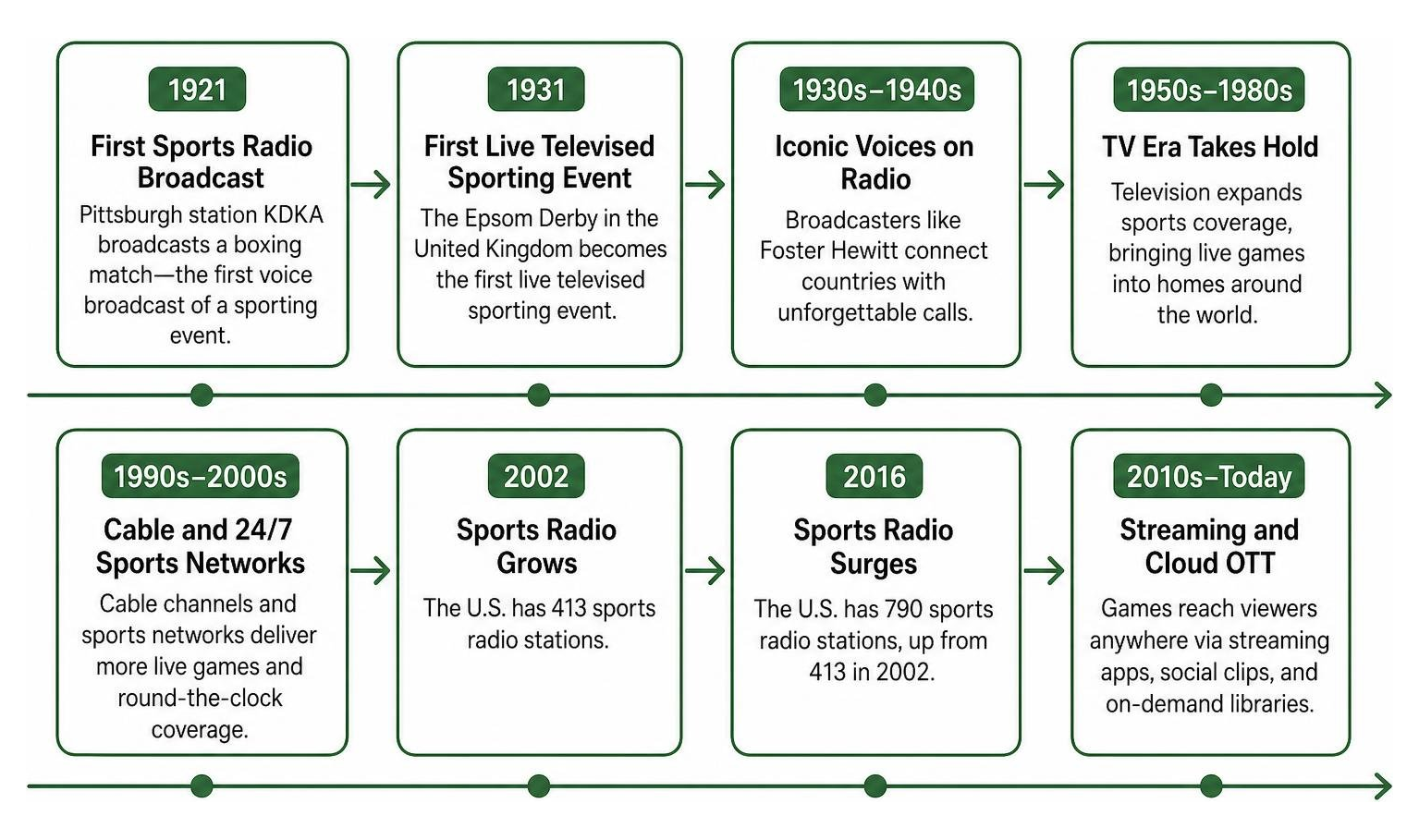
Sports media has come a long way. A boxing match broadcast by Pittsburgh station KDKA in 1921 is widely recognized as the first voice broadcast of a sporting event. Sports radio remains a substantial part of the U.S. audio landscape, with current directories listing hundreds of stations dedicated to the format. The audience still wants the live moment, but now expects it wherever they watch.
The Evolution and Infrastructure of Modern Sports Broadcasting
From Early Radio and Derby Broadcasts to Global Rights Distribution
Live sports media has always pushed the boundaries of available technology. Before video feeds or audio transmissions existed, fans gathered in city centers around mechanical telegraph boards that simulated football plays miles away. The medium leaped forward when the 1931 Epsom Derby in the United Kingdom became the first live televised sporting event. Soon after, iconic voices like Foster Hewitt in Canada connected entire countries with phrases like “Canada!” echoing across radio airwaves.
As consumer access transformed from early radio to linear cable and streaming platforms, the business models governing sports programming shifted dramatically. Today, rights distribution differs significantly around the globe:
- United States: Dominated by commercial networks and regional sports networks (RSNs), premium live sports drive astronomical values. The NFL generates more than $6 billion annually from television rights alone, accounting for over half of its overall revenue.
- United Kingdom and Ireland: Regulated heavily by “anti-siphoning” laws that designate specific major cultural and sporting events for free-to-air television, preventing pay-TV providers from placing everything behind subscription paywalls.
- Canada: A hybrid model where national networks balance public broadcast heritage with commercial cable sports ecosystems.
- Continental Europe: Tiered premium rights packages, exemplified by the UEFA Champions League where television rights command massive national fees across markets such as the UK, Italy, Spain, Germany, and France.
For modern broadcasters and networks, handling global distribution requires infrastructure that can scale to deliver international feeds in real time. We see this immense scale during premier international tournaments, including the historic FIFA World Cup 2026 coverage, where networks coordinate live broadcasts on scheduled TV channels alongside native 4K digital streams for 104 matches.
The Impact of Technology and Digital Streaming on Sports Broadcasting
The transition from standard-definition airwaves to high definition in the late 1990s laid the foundation for today’s digital video revolution. Modern sports organizations no longer operate solely as teams playing a weekend schedule; they are 24/7 always-on media enterprises. High-profile programs, such as the Sunday Night Football multi-platform broadcast, require simultaneous deliveries across scheduled television channels, internet-delivered subscription streaming services, dedicated mobile applications, and Spanish-language companion feeds.
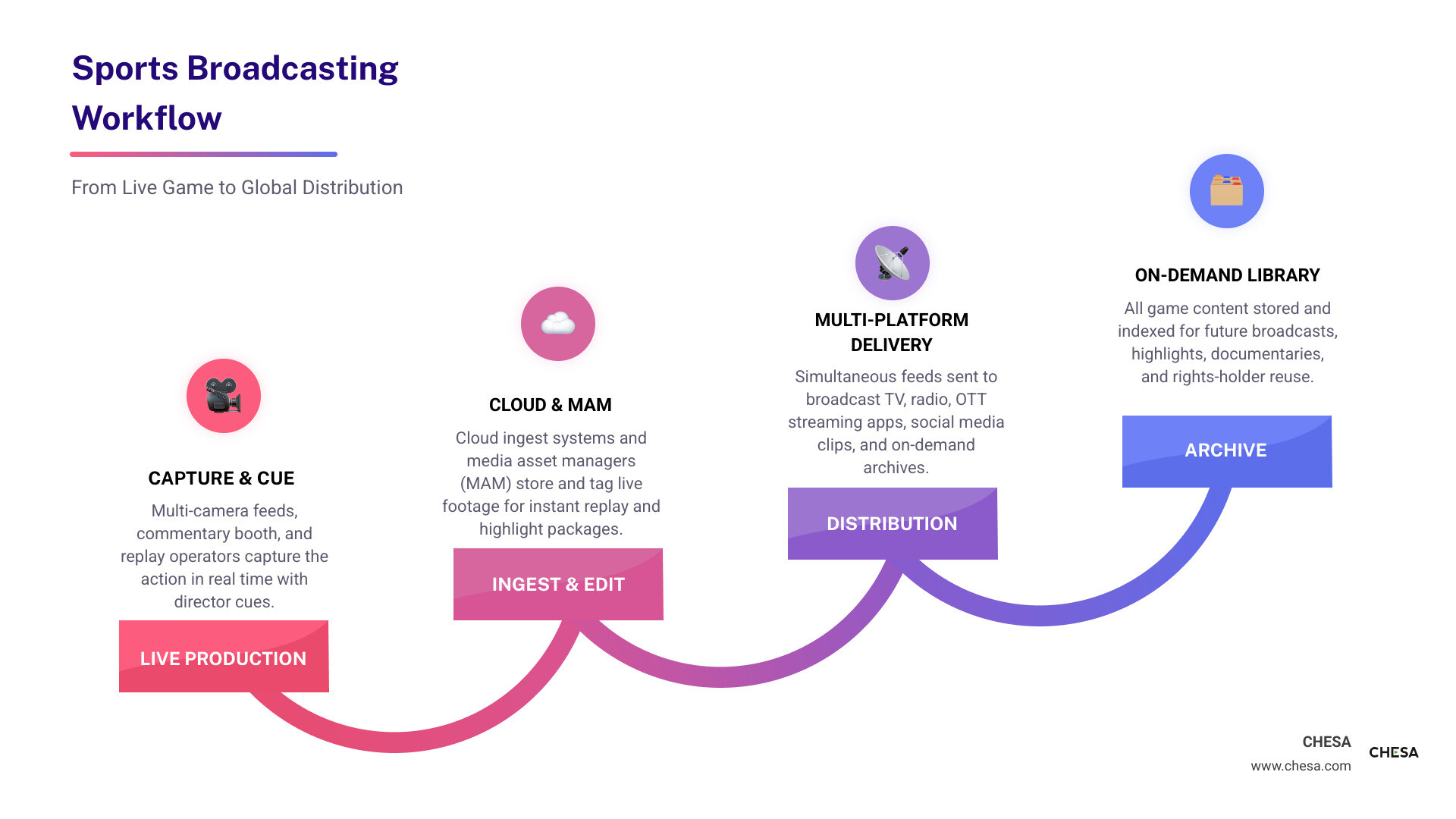
Behind every smooth live stream sits complex technical plumbing. Modernizing live workflows requires specialized broadcast systems integration to connect field cameras, graphics tools, replay systems, and automated cloud tools that convert video into the formats each platform needs.
At modern sports networks and venues, video engineering teams use automated workflows that capture live stadium feeds for clips and other content in cloud systems or a mix of cloud and on-site systems. For instance, the Monumental Sports production workflow demonstrates how regional sports operations use Media Asset Management (MAM) platforms—systems for organizing and finding media—to capture, edit, tag with AI, and archive live video with high data rates instantly. This allows social media teams and post-production editors to clip game-winning plays and deliver them to fans’ mobile feeds seconds after they occur on the field.
Key Roles Across On-Air Talent and Production Crews
On-Air Commentary: Play-by-Play, Color Analysis, and Sideline Reporting
A high-quality sports broadcast requires seamless communication between announcers in the booth and reporters on the field. Modern sports media professionals often shift between play-by-play, analysis, studio hosting, and sideline reporting, bringing adaptability and preparation to every live production.
The core on-air team divides responsibilities to keep the presentation informative and engaging:
- Play-by-Play Announcer: The primary narrator of the broadcast who describes the immediate action with clarity, rhythm, and accuracy. This commentator sets up storylines, tracks jersey numbers and clock management, and orchestrates on-air handoffs to team members.
- Color Analyst (Game Analyst): Often a former coach, player, or seasoned sports analyst who explains the why and how behind the play. They break down tactical formations, analyze mistakes, and decode strategy between game pauses.
- Sideline / Field Reporter: Positioned at field level to provide breaking injury updates, weather updates, dugout culture notes, and live interviews with coaches and athletes.
- Studio Host: Anchors pre-game, halftime, and post-game coverage, synthesizing storylines across concurrent games and keeping panel discussions lively and structured.
Unlike scripted entertainment, live commentators work without teleprompters. They build detailed spotting boards that match player names to jersey numbers, color-coded rosters, and statistical notes throughout the week to deliver real-time insight the split second an unexpected play happens.
Behind-the-Scenes Production: Directing, Replay Operation, and Engineering

While the on-air talent provides the voice, a team inside the mobile production truck shapes the visual story. A typical live professional broadcast relies on dozens of specialized crew members:
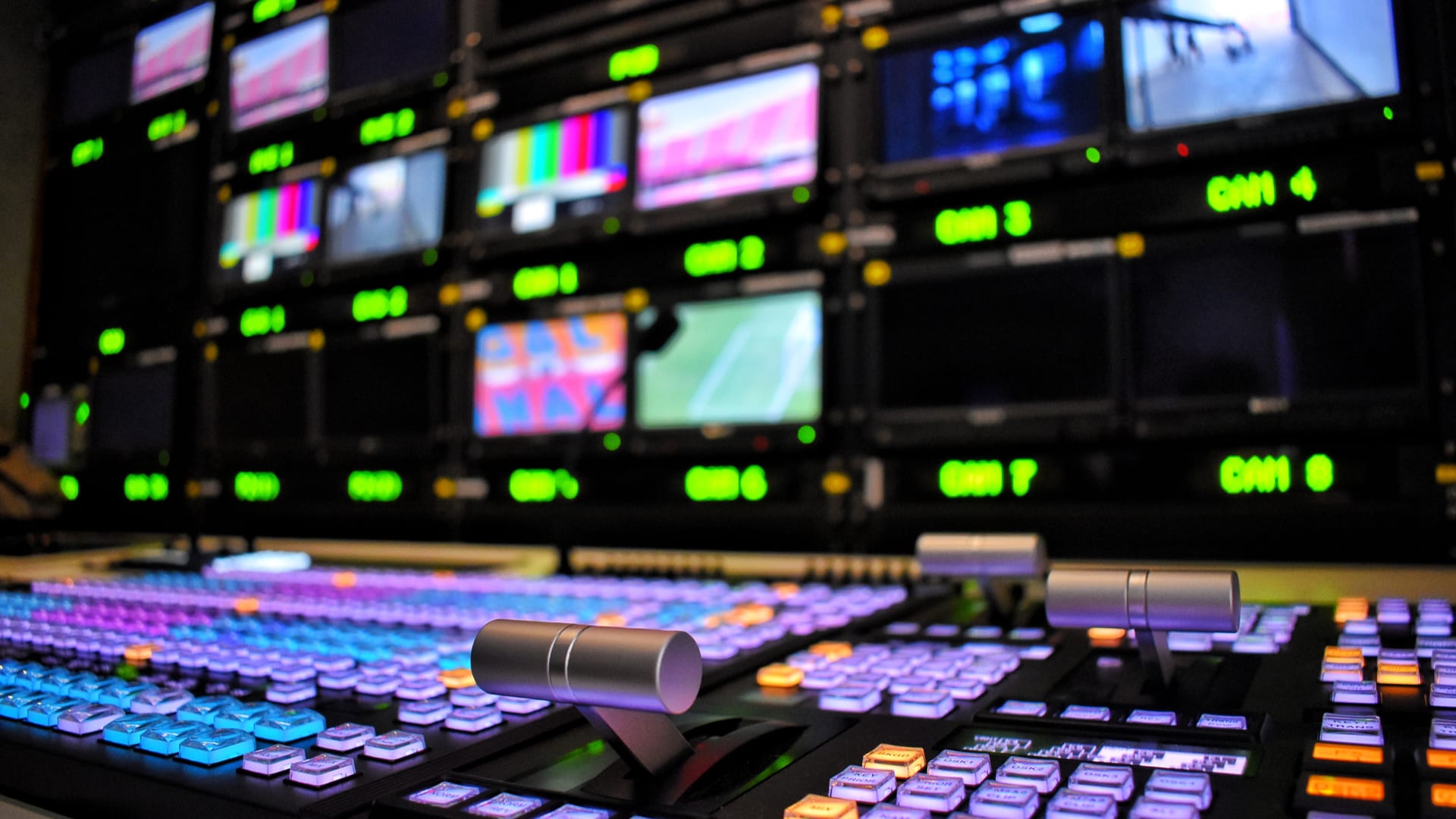
- Director: Selects live camera feeds in real time from a multi-monitor wall, calling rapid switches (“Ready 2, Take 2”) to match the game’s rhythm.
- Producer: Acts as the broadcast’s executive leader, guiding the overall narrative, cueing commercial breaks, balancing replay packages, and speaking directly into the announcers’ earpieces through IFB (interruptible foldback) systems, which let production staff send private audio cues to on-air talent.
- Technical Director (TD): Operates the video switcher, executing cuts, wipes, graphics transitions, and video source routing on the director’s direct cue.
- Replay Operator: Controls multi-channel replay servers to instantly clip, cue, and slow down critical plays from various angles for immediate broadcast breakdown.
- Audio Engineer (A1): Mixes dozens of live stadium crowd microphones, dish-shaped microphones that pick up distant on-field sounds, player mics, and talent headsets to deliver balanced stadium audio.
Modern directors routinely look beyond standard wide shots to create emotional storytelling. Directors use cameras that keep the subject sharp while softening the background, along with film-inspired framing during game downtime to highlight player emotion. Maintaining that level of polish requires announcers, replay technicians, and camera crews to remain in lockstep. The rapid evolution of these technical setups was heavily accelerated by sports broadcast production innovations, which proved that distributed, remote, and hybrid workflows could deliver broadcast-grade productions.
Modernizing Sports Media Workflows and Infrastructure
Define Workflow Requirements Before Choosing Technology
Start with the workflow, not the shopping list. Map how footage moves from capture to editing, distribution, and archive. Then identify where teams wait for transfers, struggle to find clips, or repeat manual tasks.
If your organization exchanges footage with collegiate athletics programs or other production partners, include those handoffs in your requirements. Define who needs access, which formats they need, and how shared footage will be retained.
| Workflow Area | Planning Scope | Planning Questions | Requirements to Define |
|---|---|---|---|
| Capture and Handoffs | Live feeds, editing, and digital production | How quickly must captured footage reach editors and digital teams? | Required formats, transfer deadlines, and responsible teams |
| Media Access | Finding, reviewing, and reusing footage | Who needs access to find, review, and reuse footage? | User permissions and editing or publishing access |
| Storage and Distribution | Library growth, archive access, and delivery | How will storage capacity, retention, and retrieval needs change, and which channels, formats, and delivery deadlines must the system support? | Capacity estimates, retention periods, retrieval targets, and delivery requirements |
Supporting Production Teams with Accessible Media
Give production, digital, engineering, and IT teams a shared checklist for media access. Identify who needs to find footage, who can edit or publish it, and which handoffs need attention first. Use those requirements to guide your Media Asset Management (MAM) evaluation.
Plan for the library beyond game day, too. Set retention requirements, estimate storage growth, and define how quickly archived footage needs to be available. Include the people retrieving that footage in your planning—not just the people buying the system.
Whether managing camera positions in sub-zero stadium weather or configuring high-density enterprise storage, the sports media industry relies on talented professionals working behind the camera. Organizations that invest in robust asset management for sports entertainment empower these teams by eliminating workflow bottlenecks, making it simple to find, log, and utilize media assets across massive sports entertainment operations.
Frequently Asked Questions About Modern Sports Media
Where should sports media leaders start when modernizing workflows?
Start by mapping how footage moves from live capture to editing, publishing, and archive. Ask production, digital, engineering, and IT teams where delays occur. Use those requirements to evaluate integration, access, storage capacity, and support—not just individual product features.
How do team-owned networks differ from national sports channels?
Team-owned networks and regional sports networks (RSNs) focus primarily on delivering dedicated local coverage, live game access within regional market territories, and comprehensive pre- and post-game analysis for a specific franchise. Unlike national broadcast channels that buy rights for broad national audiences, team-owned platforms frequently deliver direct-to-consumer (DTC) streaming options, behind-the-scenes access, and digital content tailored specifically to their regional fan base.
Do live sports commentators use teleprompters during games?
No, live sports play-by-play commentators and color analysts do not use teleprompters while calling live action. Because sporting events are completely unscripted and unpredictable, commentators rely on custom game-day charts matching player names to jersey numbers, dynamic statistical monitors in the booth, historical research binders, and direct audio cues from their producers to deliver live context as the action unfolds.
Conclusion
Sports storytelling has grown from scratchy radio broadcasts of boxing matches into a high-octane, multi-platform media universe. Whether you lead broadcast operations, manage production, or plan infrastructure that combines cloud and on-site systems, success comes down to preparation, teamwork, and workflows that connect live coverage with content delivery and reuse.
At CHESA, we live and breathe this technology. We design, build, integrate, and support end-to-end media systems—including Media Asset Management (MAM), fast media import, cloud-based video format conversion, scalable storage, and long-term archiving—for top broadcasters, venues, and athletic programs. If your team is ready to eliminate bottlenecks, automate live-to-digital clipping, and build scalable infrastructure, explore our professional sports media solutions and let’s transform your media operations together.