
Why Remote Production Makes Live Broadcasts More Agile
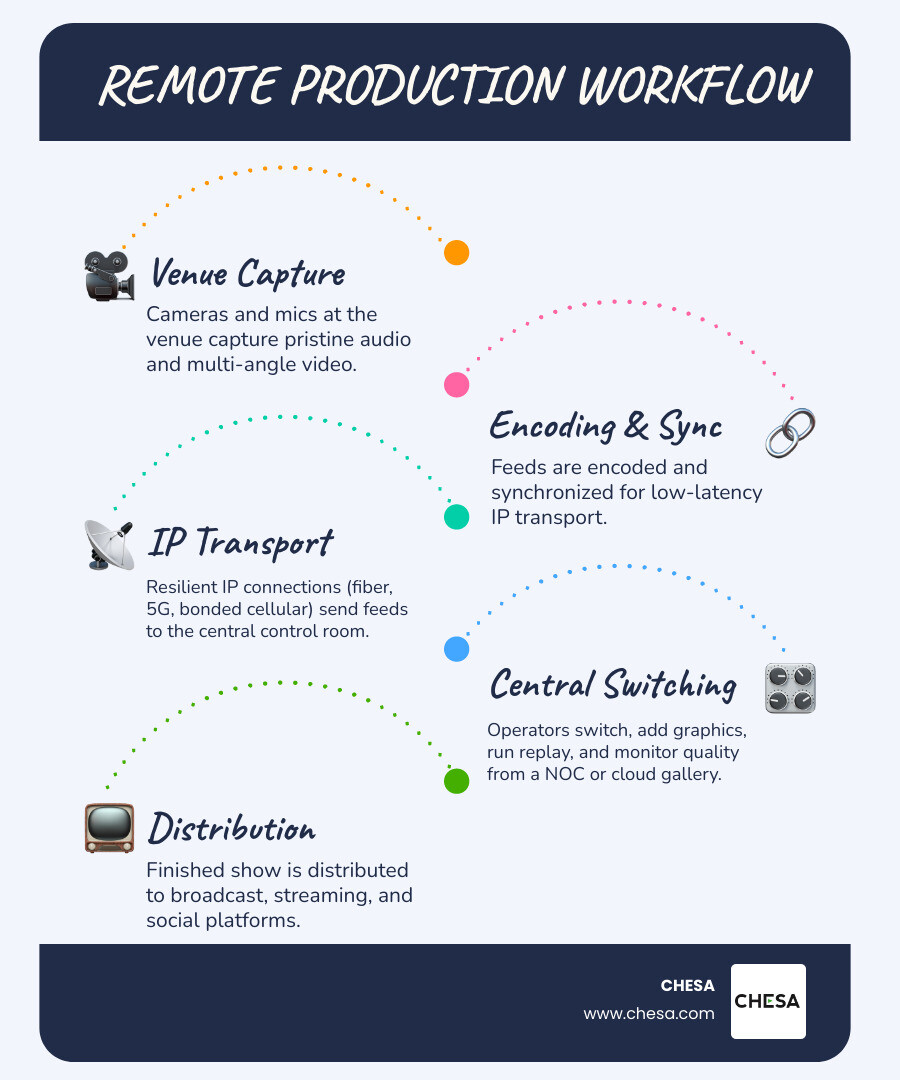
To implement remote production, keep cameras, microphones, and a small technical crew at the venue, then send synchronized feeds over resilient IP connections to a central control room or cloud gallery. From there, your team can switch, add graphics, run replay, monitor quality, and distribute the finished show to broadcast, streaming, and social platforms.
Start with three practical moves:
- Audit venue connectivity and plan primary plus backup paths, such as fiber, wired internet, and bonded cellular.
- Standardize low-latency transport and timing so feeds stay secure, synchronized, and usable for live decisions.
- Centralize repeatable production roles like switching, replay, graphics, and engineering to support more events with the same core team.
This model reduces the need to move a full production truck and large crew to every event. It also helps media teams cover more venues, launch more streams, and keep live content flowing into their archive. That matters: 43% of broadcast respondents identified enabling remote production as their organization’s top priority.
I’m Jack Wyrick, and the next sections break down the operating models and technical building blocks that turn this from a good idea into a reliable live workflow. For a broader look at how distributed teams are reshaping broadcast operations, see remote production.
Core Models of Remote Production: Traditional REMI vs. Reverse Operations
Live sports production used to mean rolling massive outside broadcast (OB) trucks, running thousands of feet of copper, and putting fifty people on planes for every match. Today, modern operations move bits instead of bodies.
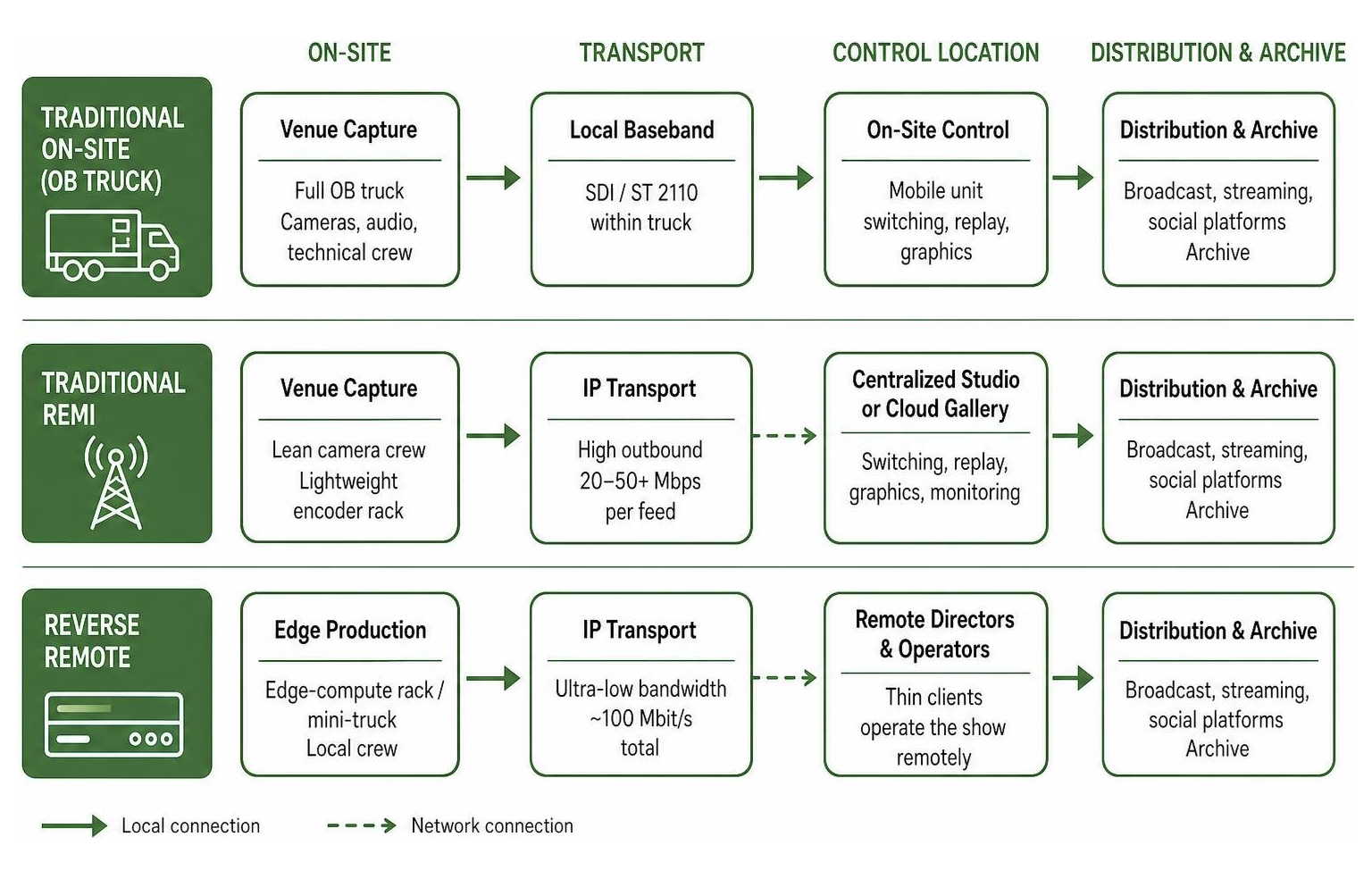
The traditional Remote Integration Model (REMI) captures pristine audio and multi-angle video at the field, encodes those feeds instantly, and ships them across IP pipes back to a centralized Network Operations Center (NOC) or cloud control room. That is how NASCAR consolidated its operations to a single studio in Charlotte, producing 30 live events remotely in a single season. Similarly, leagues like the Premier Hockey Federation and the National Women’s Soccer League leveraged REMI to turn niche availability into linear television packages, airing full tournament seasons while keeping field-side operational overhead down to a fraction of a massive production truck setup.
| Production Model | On-Site Footprint | Bandwidth Demand | Control Location | Best Used For |
|---|---|---|---|---|
| Traditional On-Site | Full OB truck, 30–60+ crew, hardware racks | Local baseband (SDI/ST 2110) | On-site mobile unit | Massive tentpole events with zero connectivity |
| Traditional REMI | Lean camera crew, lightweight encoder rack | High outbound (20–50+ Mbps per uncompressed/mezzanine feed) | Centralized studio hub / Cloud gallery | Multi-venue sports leagues, rapid multi-city schedules |
| Reverse Remote | Edge-compute rack/mini-truck, local crew | Ultra-low (approx. 100 Mbit/s total) | Remote directors/operators on thin clients | Multi-hub international broadcasts, limited pipe venues |
When high-bandwidth pipes aren’t available at every site, reverse remote production flips the equation. Instead of pushing twenty discrete camera feeds across the country, you place edge compute hardware right in the venue or a compact support vehicle. The vision mixer, audio engine, and replay servers run on-site. The crew sits hundreds of miles away in their home control rooms, operating the gear over standard low-bandwidth internet using ultra-low-latency multiviewer streams and control data. Broadcasters covering global soccer tournaments routinely embrace this model—pairing gallery hubs across cities like London and New York with remote venue ingest to deliver resilient, world-class coverage without crushing bandwidth bottlenecks.
Centralized Control Hubs and Cloud Gallery Routing
Centralizing your production gallery changes everything. When your vision mixers, replay operators, and graphics designers work out of a unified facility, you eliminate travel fatigue and unleash massive operational synergy. A single replay operator can handle an afternoon college basketball game in Philadelphia, take a short break, and cut packages for an evening matchup in Denver.
Modern routing fabrics split the director’s multiviewer feeds from the raw camera signals, passing low-latency proxy video across WebRTC or SRT to remote operator panels. Navigating these transitions requires understanding the cultural and operational shifts in cloud native live production, ensuring your engineering teams adapt to software-defined routing rather than physical patch bays.
On-Site Processing and Edge Compute Rigs
You do not always need a 53-foot double-expando trailer taking up loading-dock space. Highly portable edge-compute broadcast rigs pack enterprise-grade switching, audio DSPs, and encoding engines into a handful of shock-mounted flyaway racks.
In a reverse remote configuration, a full multi-camera live broadcast can run smoothly over roughly 100 Mbit/s of standard internet connectivity:
- Platform & Hardware Control: ~25 Mbit/s
- WebRTC Operator Multiviewers: ~25 Mbit/s
- SRT Master Program Egress: ~25–50 Mbit/s
This footprint frees your technical teams to roll into tight arena basements, hook into available power and internet, and go live in minutes rather than days.
Technical Implementation: Step-by-Step Architecture for Agile Live Feeds
Building a bulletproof remote workflow requires a synchronized chain where capture, transport, execution, and delivery link together without dropped frames or creeping latency.
Step 1: Venue Capture, Encoding, and Synchronization for Remote Production
The foundation of every live broadcast is absolute frame precision. When a play happens at the goal line, camera one, camera eight, and the super-slow-mo feed must align down to the millisecond. Professional hardware encoders achieve glass-to-glass latency as low as 100ms, encoding high-fidelity 4:2:2 10-bit color signals to preserve broadcast grade imagery for fast-motion athletics.
Phase synchronization is maintained using Precision Time Protocol (PTP) IEEE 1588 grandmasters or local Genlock generators on-site. If you are modernizing your signal paths, transitioning from legacy SDI to ST 2110 unlocks pure IP routing, making it straightforward to pass uncompressed or lightly compressed video streams directly into your network interface cards.
Step 2: Resilient Transport Over Public Internet, 5G, and Dedicated IP
Once encoded, feeds need to cross the open internet without succumbing to jitter, packet loss, or network degradation. The open-source Secure Reliable Transport (SRT) protocol has become the industry workhorse, wrapping streams in 128/256-bit AES encryption while applying intelligent ARQ (Automatic Repeat reQuest) packet recovery.
For roaming cameras and remote venues lacking dedicated fiber, bonded cellular links (aggregating multiple 5G networks alongside satellite connections) provide uninterrupted mobility. Broadcasters combine these streams with SMPTE ST 2022-7 hitless failover, sending identical dual paths over separate internet service providers so that a severed line causes zero visual interruption on air. This creates the reliable foundation needed for real time collaboration and feedback loops in cloud native media workflows.
Step 3: Centralized Switching, Live Replay, and Virtual Graphics
At the central production hub, incoming feeds land on your primary vision mixer and live replay engines. Switcher operators can work with physical tactile panels or responsive virtual control surfaces.
Because the heavy lifting occurs inside a standardized gallery, engineering teams can integrate cutting-edge graphics engines—such as real-time Unreal Engine rendering for augmented-reality field overlays and mixed-reality studio backgrounds. Integrating automation into these vision mixers accelerates turnaround times, though technical leads should recognize when machines enter the control room to strike the right balance between automated cues and human storytelling.
Step 4: Live-to-Archive Handoff and Content Monetization
The final whistle should not mark the end of your content pipeline; it is where the monetization sprint starts. Today’s professional sports organizations function as 24/7 digital media enterprises. As your switcher cuts the main program, automated ingest engines capture full-resolution ISO feeds and master deliverables directly into cloud object storage.
Modern platforms leverage integrated double-ender local recording—capturing zero-frame-loss master files directly at the edge or encoder stage while streaming low-bitrate proxies for switching. This protects the pristine recording from unexpected network drops. Connecting these incoming streams directly into a robust media asset management platform allows editors to pull tagged highlights and social clips in seconds:
- Instant Clip Generation: Tag metadata on live markers (goals, fouls, home runs) for instant export to mobile apps.
- Master ISO Ingest: Ingest uncompressed master files straight into central post-production storage.
- Automated Proxy Generation: Spin up lightweight editing proxies for distributed remote editors.
- Archive Cataloging: Automatically index transcripts, facial recognition, and OCR score tracking for long-term licensing.
Managing Infrastructure, Network Latency, and Operational Bottlenecks
Moving to distributed live workflows introduces specific network and operational hurdles that broadcast engineers must manage proactively.

Technical Bottlenecks in Scaling Remote Production
The toughest enemy in live sports broadcasting is timing mismatch. If your wide sideline camera arrives at the switcher 120ms behind your tight field camera, live cuts will produce disorienting visual jumps.
Engineers must properly size jitter buffers and calibrate time-alignment delays at the decoder stage. Communication channels present another common bottleneck: director-to-camera tally signals and low-latency IFB (interrupted foldback) audio talkback cannot tolerate lag. Resolving these performance limits requires addressing the core scalability and performance challenges in cloud native media workflows across all edge devices and switches.
Security, Data Integrity, and Multi-Feed Redundancy
Broadcasting unreleased live feeds over public wide-area networks demands robust security protocols. Unencrypted RTSP streams or exposed IP ports leave signals vulnerable to interception or disruption.
Production ecosystems must enforce end-to-end stream encryption (such as SRT with pre-shared keys), establish secure IP-over-GRE or WireGuard tunnels for remote camera control, and deploy strict role-based access control across all software consoles. Maintaining distinct broadcast, control, and corporate network segments isolates critical live feeds from public network vulnerabilities.
Frequently Asked Questions About Live Event Broadcasting
How much glass-to-glass latency does a typical REMI workflow introduce?
Modern hardware-accelerated REMI systems typically achieve 100ms to 300ms of glass-to-glass latency over dedicated or optimized public IP connections. Using high-efficiency mezzanine codecs (such as HEVC or JPEG-XS) keeps encoding and decoding times under a single frame, providing immediate responsiveness for remote directors and talent return feeds.
Can reliable multi-camera remote broadcasts operate over the public internet?
Yes. Protocols like SRT and RIST use intelligent packet-loss recovery and dynamic jitter buffering to deliver broadcast-quality video over public broadband and 5G networks. When paired with frame-accurate time synchronization and bonded cellular backup, multi-camera live events run reliably without dedicated dark fiber.
What is the primary difference between REMI and reverse remote production?
The difference lies in where the primary processing takes place:
- Traditional REMI: Raw camera and audio feeds are sent over the network to be mixed, switched, and processed at a central facility.
- Reverse Remote Production: Video mixing and heavy rendering happen on-site at the venue via edge servers, while remote operators control the gear over low-bandwidth multiviewer proxies and IP data connections.
Conclusion: Building Future-Ready Live Event Operations
The shift toward distributed, agile live broadcasting is no longer an experiment—it is the operating model defining modern sports and entertainment media. Centralizing talent, trimming on-site footprints, and harnessing flexible edge-and-cloud workflows empowers production teams to cover more matchups, elevate storytelling quality, and monetize content across digital channels at unprecedented speed.
Making this transition seamlessly requires an architecture tailored to your unique broadcast demands. At CHESA, we design, build, integrate, and support end-to-end systems that bridge the gap between venue capture, cloud routing, media asset management, and long-term storage. Whether you are upgrading legacy SDI facilities, expanding your multi-channel delivery, or deploying agile flypacks, explore our end-to-end media workflow integration for professional sports and let’s build an infrastructure that keeps your operations fast, agile, and ready for whatever comes next.