
The Seismic Shift in Sports Media Distribution: Streaming, DTC, and RSN Reinvention
Modern sports media is no longer built around one cable channel, one nightly highlight show, or one control room. Rights-holders now need a distribution model that can serve local television viewers, authenticated streaming audiences, direct-to-consumer subscribers, social platforms, and in-venue displays—often from the same live production.
The cable bundle is still part of the picture, but it is no longer the automatic center of gravity. Teams, leagues, and networks are taking more ownership of the customer relationship, especially as fans expect games, highlights, alternate feeds, and archives to be available on the devices they already use.
That shift does not mean every organization must launch a standalone app tomorrow. It does mean media leaders need to know where their content lives, who can access it, and how quickly it can move from a stadium feed to every approved destination.

Forward-looking organizations are combining owned distribution with trusted partners. The operational lessons from our DCMUG event at Monumental Sports are clear: content operations, storage, metadata, and delivery workflows must be designed together—not bolted on after a rights deal is announced.
When a team produces more of its own feeds, it needs enterprise-grade workflows to ingest, organize, secure, and distribute a rapidly growing library. Our work with Kroenke Sports & Entertainment illustrates why fast, intelligent access to media assets matters when footage has value across live, social, sponsorship, archive, and venue channels.
Amazon, Apple, and Major Platforms Reshaping Rights
The next NBA media-rights cycle is already changing the production and distribution conversation. The NBA’s agreements with Disney, NBCUniversal, and Amazon Prime Video create a broad mix of broadcast, cable, and streaming windows, with Prime Video carrying an exclusive package beginning with the 2025–26 season. The NBA’s announcement shows why rights-holders now need flexible workflows that can support multiple partners instead of a single linear outlet.
Apple’s long-running MLS partnership and MLB’s increasingly fragmented viewing options point to the same reality: fans may follow one club across several platforms during a season. Apple’s MLS coverage and MLB’s 2026 viewing guide are useful reminders that discoverability, regional availability, and distribution rights are now part of the fan experience.
For production teams, the challenge is not simply delivering a clean program feed. It is preparing the same live moment for alternate commentary, personalized graphics, near-real-time highlights, ad-supported digital inventory, and approved social clips without creating a maze of manual handoffs.
| Capability | Traditional Linear-First Workflow | Modern Multi-Platform Workflow |
|---|---|---|
| Primary output | One scheduled program feed | Multiple live, on-demand, and short-form destinations |
| Audience relationship | Distributor owns most viewer data | Rights-holder can build consented first-party audience data |
| Versioning | Limited regional or language variations | Alternate feeds, captions, languages, and platform-specific cuts |
| Operations | Separate broadcast and digital teams | Connected production, MAM, archive, and publishing workflow |
| Monetization | Affiliate fees and traditional ad spots | Sponsorship, subscriptions, dynamic ads, commerce, and licensing |
The Local Broadcast Pivot: OTA Reach Meets Team-Controlled Streaming
Local access remains strategically important. Free over-the-air television can help teams reach casual fans and households that do not maintain a pay-TV subscription, while streaming products can offer premium features such as replays, alternate feeds, and behind-the-scenes programming.
The winning model is rarely one-size-fits-all. It is a rights-aware hybrid: make the live game easy to find, give superfans a reason to engage more deeply, and ensure every distribution partner receives the correct version on time.
That requires practical technical discipline. Media organizations must manage localized feeds, rights restrictions, captions, graphics packages, advertising markers, and rapid clipping from a single reliable source of truth. What once felt like a backup plan is now the operating model: remote production, scalable infrastructure, and cloud-connected workflows are part of everyday sports media delivery.
Whether you are coordinating multi-city broadcasts or running a venue operation like the Philadelphia Phillies, the production engine has to be fast, connected, and built for the next rights window, not the last one.
The Talent Revolution: Athlete-Led Production and the Creator-Partner Model
Sports networks no longer hold all the leverage over on-air talent. Athletes, former athletes, journalists, and entertainers can build direct audiences through podcasts, YouTube, newsletters, short-form video, and live events before a traditional network ever calls.
That changes the deal. Instead of hiring a host to read a prompter, networks increasingly partner with a creator-led production operation that brings an established voice, audience habits, a distribution engine, and recognizable intellectual property.
Peyton Manning’s Omaha Productions and the ManningCast helped establish the alternate-broadcast playbook: credible football conversation, flexible guest booking, and a format that feels materially different from the main telecast. The important takeaway for media operators is not to copy a famous personality. It is to build a production stack that makes differentiated formats possible without compromising the live-event workflow.
How Athlete-Driven Content Reshapes Modern Sports Media
Fans often respond to expertise that feels lived-in rather than scripted. Retired players can explain a tactical adjustment, locker-room dynamic, or travel reality in a way that adds context to the game; active athletes can give audiences a more personal window into training and culture when rights and brand safeguards are clear.
Creator-led programming also raises the quality bar for the infrastructure behind it. A show may need live remote guests, a clean archive of clips, vertical social versions, branded graphics, transcripts, and rapid approval workflows—sometimes all from the same daily production.
The smartest teams treat athlete and creator content as an operating model, not a one-off marketing stunt. Define ownership, rights, archival requirements, sponsorship approvals, clip permissions, and delivery standards before the first show goes live. That avoids the classic problem of discovering after a viral moment that nobody can locate the clean master file.
Building Reach Without Chasing Every Trend
The opportunity is real, but a recognizable host is not a media strategy by itself. Sports organizations should focus on repeatable formats that connect a specific audience need with a sustainable workflow:
- Alternate live experiences for fans who want more personality, analysis, or team-specific context.
- Shoulder programming that extends the conversation before and after games.
- Fast, rights-cleared social clips that create discovery without sacrificing long-form value.
- Searchable archives that let producers reuse interviews, historic plays, and evergreen storytelling.
- Clear brand and sponsor controls that protect both the creator and the rights-holder.
The result should feel spontaneous to fans while remaining organized behind the scenes. That combination—authentic talent plus dependable production operations—is much harder to replicate than a clever clip on its own.
Sports Journalism at the Crossroads: Speed, Authority, and Audience Trust
Creator-led shows and short-form highlights have expanded the sports-media ecosystem, but they have also put pressure on traditional reporting. Every newsroom is competing in an environment where a breaking-news post can travel worldwide in seconds and audiences expect immediate video, context, and reaction.
That speed is valuable, but it is not the same as authority. The brands that earn long-term trust distinguish confirmed reporting from speculation, correct mistakes visibly, and make room for analysis that helps fans understand why a development matters.
The career change of longtime NBA reporter Adrian Wojnarowski remains a useful signal of how demanding the always-on news cycle can be. His move from ESPN to a role at St. Bonaventure underscored the personal cost of the continuous scoop race—and why media organizations need sustainable reporting, editing, and publishing practices rather than relying on individual heroics.
Balancing Journalistic Integrity With Short-Form Engagement
The right question is not whether short-form video belongs in sports journalism. It absolutely does. The question is whether a clip leads viewers toward useful reporting, original analysis, and a media brand they can trust.
For digital production teams, that calls for a deliberate content ladder: capture the live moment, publish an approved highlight quickly, add explainers and expert context, then preserve the material in an archive that can support deeper stories later. A six-second clip may win attention; a well-organized library and reliable editorial process turn attention into a durable audience.
Operationally, media teams cannot afford to wait for high-resolution files to crawl between disconnected storage systems. Editors and social producers need secure access to proxies, accurate metadata, shared review tools, and direct publishing paths while the moment is still relevant.

Cultural Narratives and Emerging Sports: Prepare for the Moment
Women’s sports, global soccer, college athletics, and emerging leagues continue to create high-demand moments that can outgrow a media operation’s normal capacity. The lesson is not to rely on a single record-setting event or one viral athlete. It is to build a repeatable system that can scale when a game, documentary, or cultural conversation captures the public’s attention.
When interest spikes, media teams need to find historic footage, create accessible multi-platform versions, collaborate across locations, and publish polished analysis without losing editorial control. Organizations that already have searchable archives, clear rights metadata, and fast distribution workflows can respond while competitors are still hunting for files.
In practical terms, audience growth is an infrastructure test. If a major moment doubles demand for clips and post-game coverage, your workflow should speed up—not become a bottleneck.
Modernizing Technical Infrastructure for Next-Generation Sports Broadcasts
Here is the part that quietly determines whether the strategy works: the technical foundation.
You can acquire valuable rights, sign compelling talent, and build a strong editorial plan. But slow storage, incomplete metadata, disconnected edit bays, and fragile delivery paths will turn every big moment into a fire drill.
Modern sports-media operations need a unified, high-performance pipeline that supports both live production and the content that follows it.
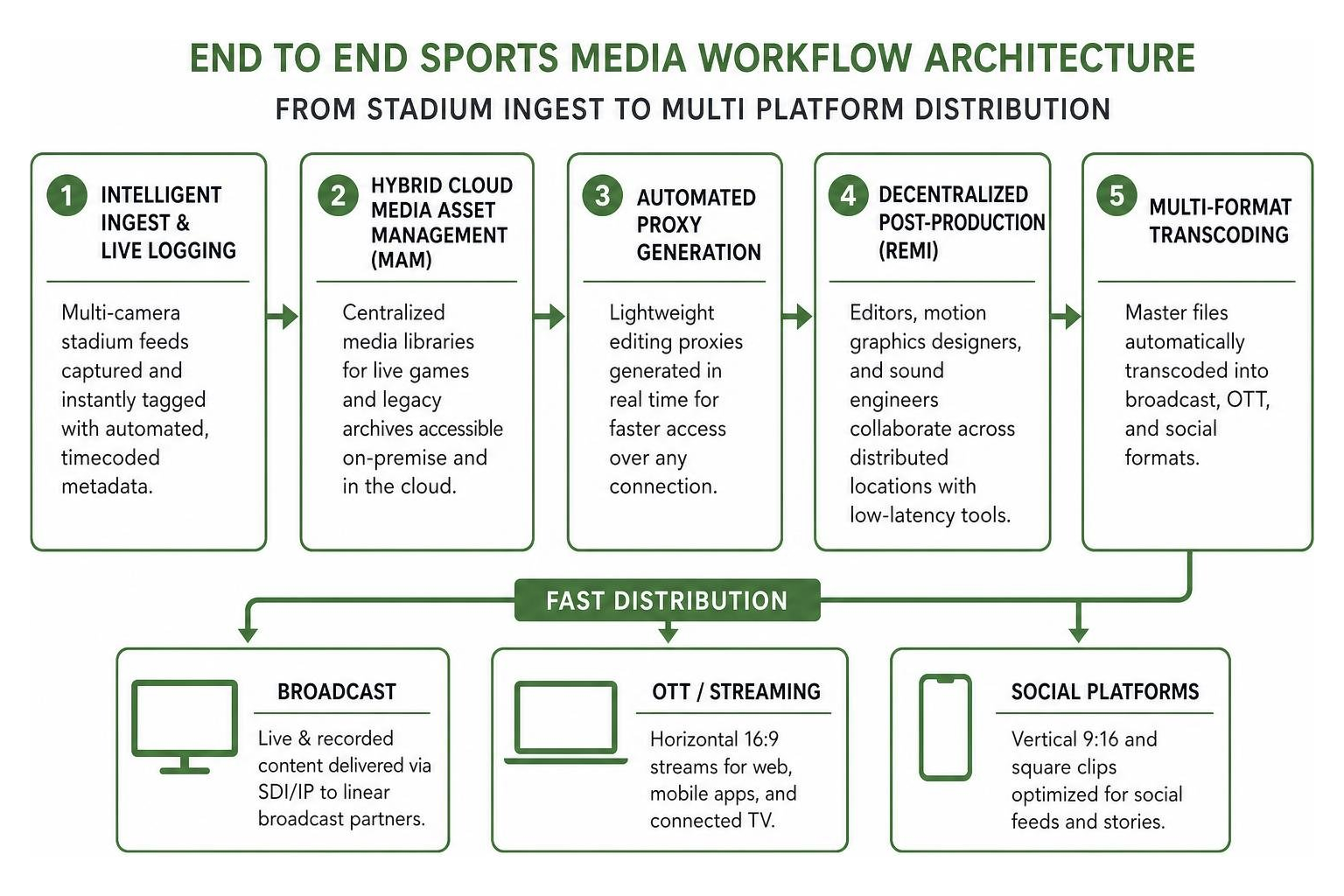
- Intelligent ingest and live logging: Capture multi-camera feeds with timecode, rights information, and usable metadata from the start.
- Hybrid-cloud media asset management: Give approved on-premises and remote users a governed way to find active game footage and historical archives.
- Automated proxy workflows: Generate lightweight, edit-ready versions quickly so distributed teams can work without moving massive camera originals.
- Collaborative remote production: Connect editors, producers, graphics teams, and engineers through low-latency, resilient workflows with clear review and approval paths.
- Multi-format packaging and distribution: Create broadcast, OTT, social, accessibility, and archive deliverables from governed masters rather than rebuilding the same asset repeatedly.
- Security and resilience by design: Protect valuable rights with role-based access, auditability, backup, and recovery processes that do not interrupt a live-event schedule.
The goal is not to chase technology for its own sake. It is to remove friction between a captured moment and the people or platforms authorized to use it.
Our discussion with Lance Hukill on cloud production infrastructure explores how organizations can add capacity when needed instead of overbuilding inflexible control-room infrastructure. Similarly, the Philadelphia Eagles video production facility demonstrates why modern facilities are planned around media creation and distribution—not just a single game-day show.
Whether you are supporting a professional franchise, league, venue, or national sports organization, the right MAM, storage, and connectivity architecture becomes a revenue-enabling platform. It makes content easier to find, faster to repurpose, safer to share, and more valuable over time.
Frequently Asked Questions About the Sports Media Landscape
How are streaming platforms changing major-league broadcast rights?
Streaming platforms are now core rights partners rather than side experiments. The current NBA agreements span Disney, NBCUniversal, and Amazon Prime Video, while services such as Apple TV and other league partners continue to make live sports a central part of their viewer-retention strategy. For rights-holders, this means planning for multiple distribution windows, technical specifications, and audience experiences from the beginning.
Why are networks partnering with athlete-owned and creator-led production companies?
Creator-led teams can bring an established audience, a distinct voice, and proven formats across podcast, video, social, and live channels. Networks benefit when those formats add a genuinely different viewing experience; creators benefit from broader distribution and production support. The partnership works best when rights, approvals, sponsorships, and archive ownership are defined upfront.
What technical workflow challenges do sports-media organizations face today?
Sports teams and media companies must create more content for more destinations with less time between capture and publication. Common obstacles include fragmented storage, missing metadata, slow file transfers, limited remote access, rights-management complexity, and inconsistent approval processes. A connected MAM, proxy workflow, and distribution pipeline reduces those delays.
What should a sports organization prioritize before launching a new DTC or streaming initiative?
Start with the audience and rights model, then map the workflow that supports it. Confirm what content can be shown, where it can be distributed, how viewers will discover it, which data you can collect with consent, and how footage will be ingested, archived, clipped, and delivered. A polished app cannot compensate for an unreliable content supply chain.
Conclusion: Engineering the Future of Sports Broadcasting
Sports media is now an always-on business. A live game is only the starting point: the same event can drive broadcast coverage, streaming engagement, short-form discovery, sponsorship value, archival storytelling, and direct fan relationships.
The organizations best positioned for 2026 and beyond will not bet everything on one channel. They will build flexible distribution partnerships, develop formats that audiences actually want, and operate a media workflow that can move from stadium capture to approved multi-platform delivery without chaos.
That takes more than a creative idea or a shiny new app. It takes media architecture that connects ingest, storage, MAM, editing, cloud services, transcoding, collaboration, security, and archive management.
CHESA works collaboratively with sports networks and venues to understand how your operation runs today, where infrastructure is creating constraints, and what your next rights cycle and event calendar require. Whether you are planning an SDI-to-ST 2110 transition, operationalizing REMI workflows, integrating tenant requirements, or building an ongoing support strategy, CHESA can help you move forward with clarity.
Ready to modernize your broadcast pipeline and eliminate the bottlenecks holding back your content operation? Explore CHESA’s solutions for Sports Networks and Venues and build a media foundation ready for the next big rights window.


